Coach To Myiek

I have move forward with my project. This is just a preview of the first stage of my new piece. It portrays a coach driver in preparation for leaving Kawthoung for a 20 hour long journey to Myiek. The road is terrible and unpredictable. His old coach must be in a top condition before the passengers are allowed to board.

The driver looks very tired and substantially overweight. He spends his life driving his coach between those two distant cities in Myanmar.

In response to my discussions concerned with a range of ethical issues in my previous work, I have decided to select a rear view composition, my intention is to capture the character of the person but avoid direct recognition.

The next steps of the painting process will include glazing and overprinting. More developments are due to come soon.

More Exhibition Success

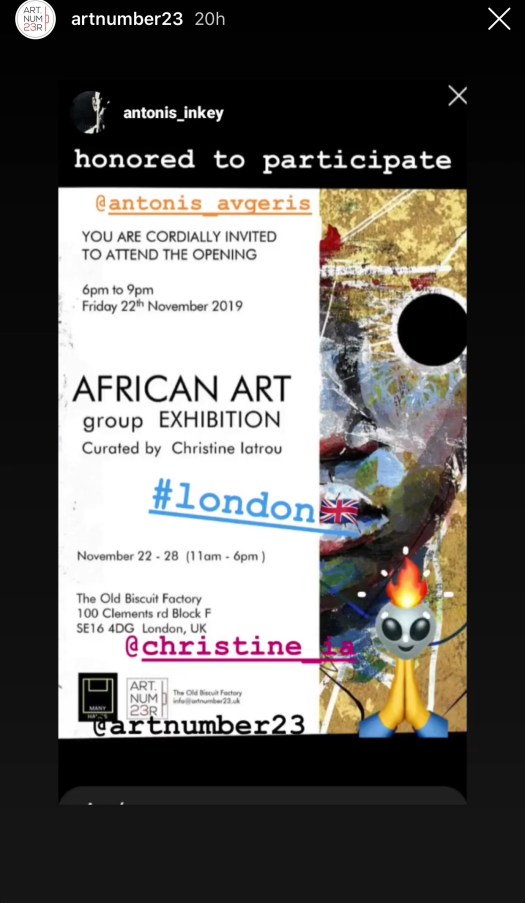
I have recently submitted work for two exhibitions. The first one is in Athens and the second in London. Both events are curated by the famous Art Number 23 at the Old Biscuit Factory In Bermondsey, London.

I have heard today that one of my pieces was chosen to be exhibited in The London based show.

Building on my recent luck, I have also completed an entry to another art completion.

Confirmation is below:

Average Art – November Edition

I was exceptionally successful in terms of having my work published in three consecutive months of June, July and August.

This has encouraged me to enter my work again.

The submitted painting questions the concept of waiting and entrapment in vacuum of life. It portrays a Burmese Captain. His monotonous and repetitive job is to operate a long boat ferry between Ranong in Thailand and Kawthaung in Mayanmar. He spends his days killing time, while chain smoking and occupying himself with his mobile phone. He is withdrawn, totally oblivious to the outstanding beauty of the area and people around him. To maximise space for the passengers, therefore increase profits, he hides himself under a colourful umbrella and crouches on the front of the deck. Continuous exposure to aggressive and scorching sun has resulted in the development of a massive tumour on his ankle. 

Confirmation email is below:

Tutorial with Jonathan

Tutorial with Jonathan Kearney
Tuesday, 15th October 2019 at 12.30. Skype call.

  1. We started by discussing the practicality of submitting my research statement via Moodle.
  2.  Jonathan felt that the reference to Burtynsky’s work was of particular value, especially his dramatic photographs of people at work and over-industrialised landscapes.
  3.  I explained that one of my models disapproved of my visual work.  Therefore, in consequence to ethical considerations, I made a decision to delete a substantial volume of experimentation.  We reflected on the idea of ownership and moralality in portraiture.
  4. We discussed my most current pieces titled: Snake Seller and Burmese Captain.  Jonathan proposed a number of new ideas and possibilities for further investigation. The main one was to include a running commentary explaining my observations of people during my research expeditions.
  5.  He also suggested that I should redefine the element of questioning in my project.  Is my work about a dialogue with my models or is it a subjective observation of how people live? Perhaps, recognising that I am using my own perspective, while looking at the Universe adds value and gives me a new potential for further development.  We agreed that a form of an audio narrative would create another layer of understanding to my work and enrich the overall experience of both viewing it and embracing my perceptions.
  6.  I have previously experimented with embedding text into images, through animation and the use of supporting commentaries.  I indicated that most people, who I have interviewed were relatively shy and reluctant to be photographed and recorded.  Therefore, it would be very difficult to gather recordings of primary sources for editing.  Jonathan suggested that I should consider using my own voice.
  7.  The project is about my subjective view, observations and individual perceptions of reality.  Therefore, all minor insights and details are important here and should be skilfully employed in order to reveal sensitive parts of the story and reinforce the meaning of the work itself – I am imposing my view of others and, subsequently, opening up the situation.
  8.  I outlined my ideas for the next stage of development.  My plan is to work with an image of a coach driver and his assistant in order to explore this concept further: waiting for the coach to fill up, waiting for its departure, for the repairs to be completed, to reach the destination… all of this only to restart the process again.
  9.  We also discussed another two opportunities to gather additional primary sources and interview people as follows:
  • illegal workers from South and Central America in Spain at Christmas.
  •  Return trip to Thailand to interview and record Burmese labourers and Thai masseurs at Easter.

Our Skype conversation ended at 13.36.

Snake Seller – Development

I have reflected on the slow process of the development and refinement of this piece.  Subsequently, I have made a decision to darken the overall image through the use of glazes and tonal overlays.  This has increased the element of drama and reinforced tiredness of the painting.  The colour scheme has become richer and more vibrant.  The intention is to echo the gloominess and monotony of daily rituals of waiting and the suspended entrapment in this cycle.  Nothing will ever change.  There is no escape.  The best result is to survive until tomorrow.

I will gradually, through careful highlighting, bring a spark of colour and light into this image.  I would like to reveal some very important details and, therefore, enhance the narrative content of this piece.

In response to my previous ethical considerations, the main character on this piece is totally anonymous.

Snake Seller 2

Snake Seller.

Some of my thinking for this piece was inspired by learning from overpowering photographs of manufacturing by Edward Burtynsky.  My attention was particularly drawn to images of miners.

‘Manufactured Landscapes’, Edward Burtynsky, courtesy of Nicholas Metivier Gallery, Toronto, available at https://www.vice.com/en_uk/article/dpk8yw/edward-burtynsky-shows-us-impending-enviro-apocalypse-in-high-definition

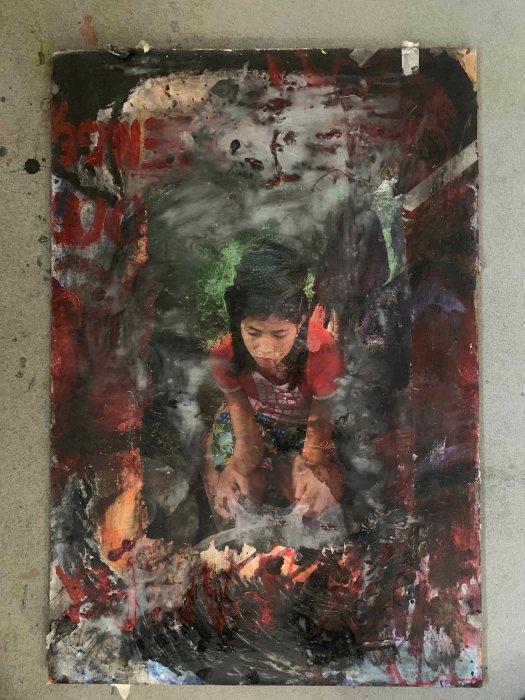
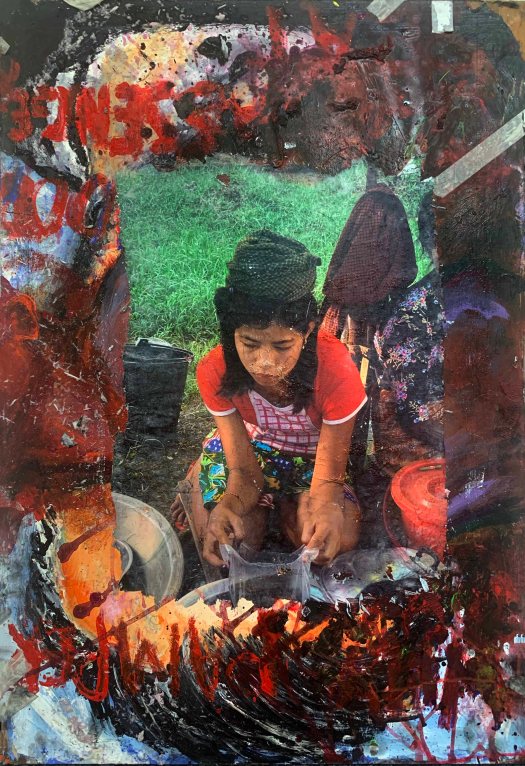
I have just started to work on a new portrait of a young woman.  She is a local worker at a market in Myiek, Myanmar.  The bazaar is based next to famous hot springs.  This increases the attractiveness of this placement and maximises potential sale opportunities.  She is a snakes vendor.  She spends all her days crouching down on her knees, while waiting for prospective customers.  Although she works outdoors, her individual stall can be seen through a window-like hole in a sheet of graffitied metal.  The contrast between brown and ochre colouring of the facade, raw redness of her T-shirt and the dynamic green of the grass make an illusion of quite dramatic and full colour compositional arrangement.

Her head is decorated with a traditional Burmese turban.  She is very serious, almost contemplative and very tense.  She looks down, perhaps away, and tries to kill time by organising one of her snakes neatly in a plastic bag, always in readiness for the next sale.

She spends most of her time waiting in anticipation for a successful transaction and making a profit.  All her days are alike, full of repetition, boredom and sameness. However, competition is tough.  Sales are limited.  This makes her existence very uncertain and fills her daily life with misery and anxiety.

I am hoping to overprint this piece with a repetitive pattern to increase the power and the overall impact.  This process will be documented in stages.

snake seller

Reflection on Kentridge

During the most recent skype session, we discussed the work of William Kentridge.  I was absolutely intrigued and fascinated by his process of repeatedly erasing and reworking charcoal drawings to create stop-frame animations.  The supporting commentary explored different ways, in which we perceive and understand the Universe.  His methodology reinforces the importance of experimentation and risk-taking; redirecting the already existing and premeditated modes of working in order to develop and refine ideas in a much more unpredictable and uncertain work.

Jonathan Kearney interpreted his work and formulated the following powerful statement:

‘Certainty can be dogmatic and arrogant, but often the perceived certainty is not very solid and the reality is much more uncertain – the value of art can be argued is in that it actively engages with uncertainty in order to discover new possibilities, ideas, surprises, etc.’


It is almost like Kentridge celebrates the value and preciousness of subjective interpretations of the world.

In response to my reflections, I have decided to experiment with my current ideas and develop them in a new, perhaps unplanned direction.

I have explored possibilities of imprinting marks and textures onto a photograph.  Following careful ethical consideration, I have decided to delete all visual work involved in this activity.  I found my work to be morally unsound.  I was faced with a very important issue in portrait making, an important dilemma.

Has the artist got the right to manipulate images depicting people and their mundane lives? My creative intentions were to provoke reflections and not to reveal dramatic existence of individual persons.