
Tutorial 2

Tutorial with Jonathan Kearney on Tuesday, 16th January 2019 at 4 p.m.
64fcc337-3b6f-49cf-878d-951ff2971455Issues discussed:

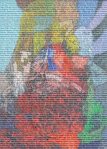
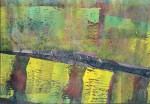
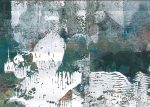
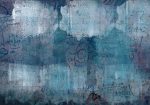
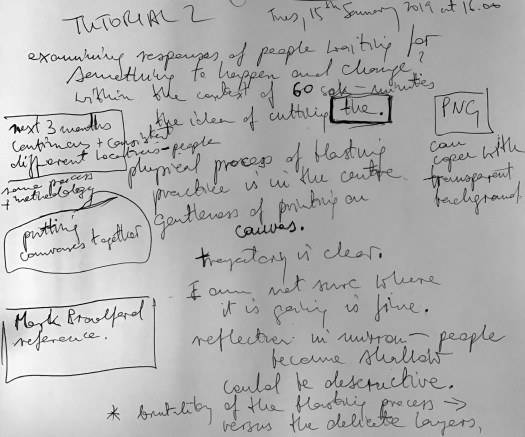
Jonathan has helped me to regain focus on what I am trying to explore during an hour-long video call on Skype.  When discussing my individual ideas, his particular attention was drawn to the brutality of the process of blasting of images in contrast to the sensitivity and gentleness of individual layers achieved.  Jonathan emphasised the value of this type of experimentation and reinforced the importance of the creative practice in visual research:

“the physical process of blasting images is in the centre of your research and practice”.

(Kearney, J. 2019)

He also suggested that my trajectory was clear and a degree of hesitance and uncertainty of direction is very much a part of the overall process of risk-taking and visual experimentation.

The option of transferring images onto reflective surfaces was discussed and partially rejected.  This is due to the destructive aspect of the behaviour of the audience in the context of this type of interaction. The attention of a viewer could be placed firmly on their “look” and impression in the mirror rather than the intended reflection on the meaning of the work.

My immediate work plan is to continue with the process of blasting images and over-layering  them using screen printing, painting and image transfer.  The portfolio of my primary sources will be triangulated and extended during the planned trip to Georgia and Azerbaijan in April, and Thailand and Burma in July and August 2019.  I will also consider using sources from my local environment.

The principle of the working process and methodology will remain the same.

It was also recommended to look at the work of Mark Bradford.  His unique collages and paintings on paper possess an organic quality and are frequently based on a grid-like composition. The surface of his work has got a highly textured, layered and almost typographic quality, making references to the dynamism of a metropolitan landscape.

This is supported by the bleeding of colour and layering.

Mark-making and painterly gestures are also very important elements in the overall work – all making a contribution to the painterly process.

Related image

Mark Bradford
B.1961
SPEAK, BIRDMAN
signed on the reverse
mixed media on canvas
59 1/2 by 70 1/2 in. 151.1 by 179.1 by cm.
Executed in 2018.
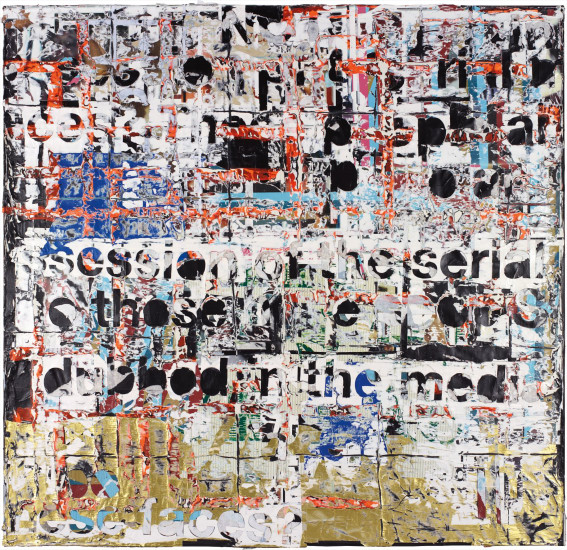
Image result for mark bradford

MARK BRADFORD

Rat Catcher of Hamelin III

mixed media on canvas
304.8 x 320 cm (120 x 125 7/8 in.)
Executed in 2011.
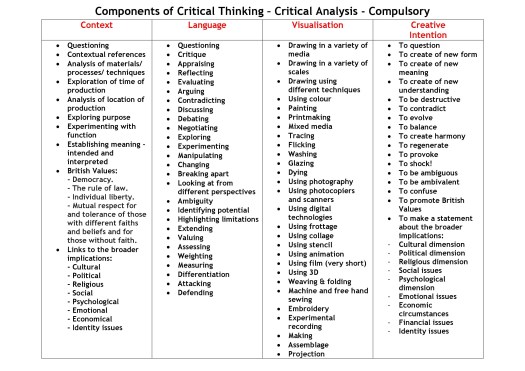
Critical Analysis

I have designed the following Critical Analysis grid in order to place my investigation firmly in the broader contexts of the potential and turbulence in the 21st century.

0001

Context:

I am questioning uncertainties of tomorrow in the context of our anxieties brought about by transience, mortality and the arrow of time.  Nothing stays the same. Everything changes inside and outside.  This is such a difficult concept to embrace and accept; agree with how our life is designed to be ephemeral and ever evolving; limited by the boundaries of birth and death.

I am linking my thought processes to the broader implications of cultural, religious, social, psychological, emotional and economical contexts.


Language:

My work seems to be a critique of the obvious and mandane; within our reach and predictable.  I am questioning my responses to extreme levels of poverty to trigger other thoughts, going far beyond survival.  I am trying to assess my ability to adapt to the unpredictable and unknowable “tomorrow”.  The project, at the moment, is open-ended and contradictory; negotiating possibilities between “I am certain” and “I am uncertain”.

Visualisation:

I am currently producing a number of painterly compositions, which are superimposed with photographs and mixed media manipulations.  This is supported by some video pieces, which extend my thought processes while questioning the idea of time and possessions.

Creative Intentions:

My objective is to question myself and my responses to having witnessed extreme poverty and life survival.  I would also like to create a new understanding of “self” and my vulnerability.  My intention is to continue to produce work, which is ambiguous and reflects my fragility with respect to the arrow of time.


Map of Time

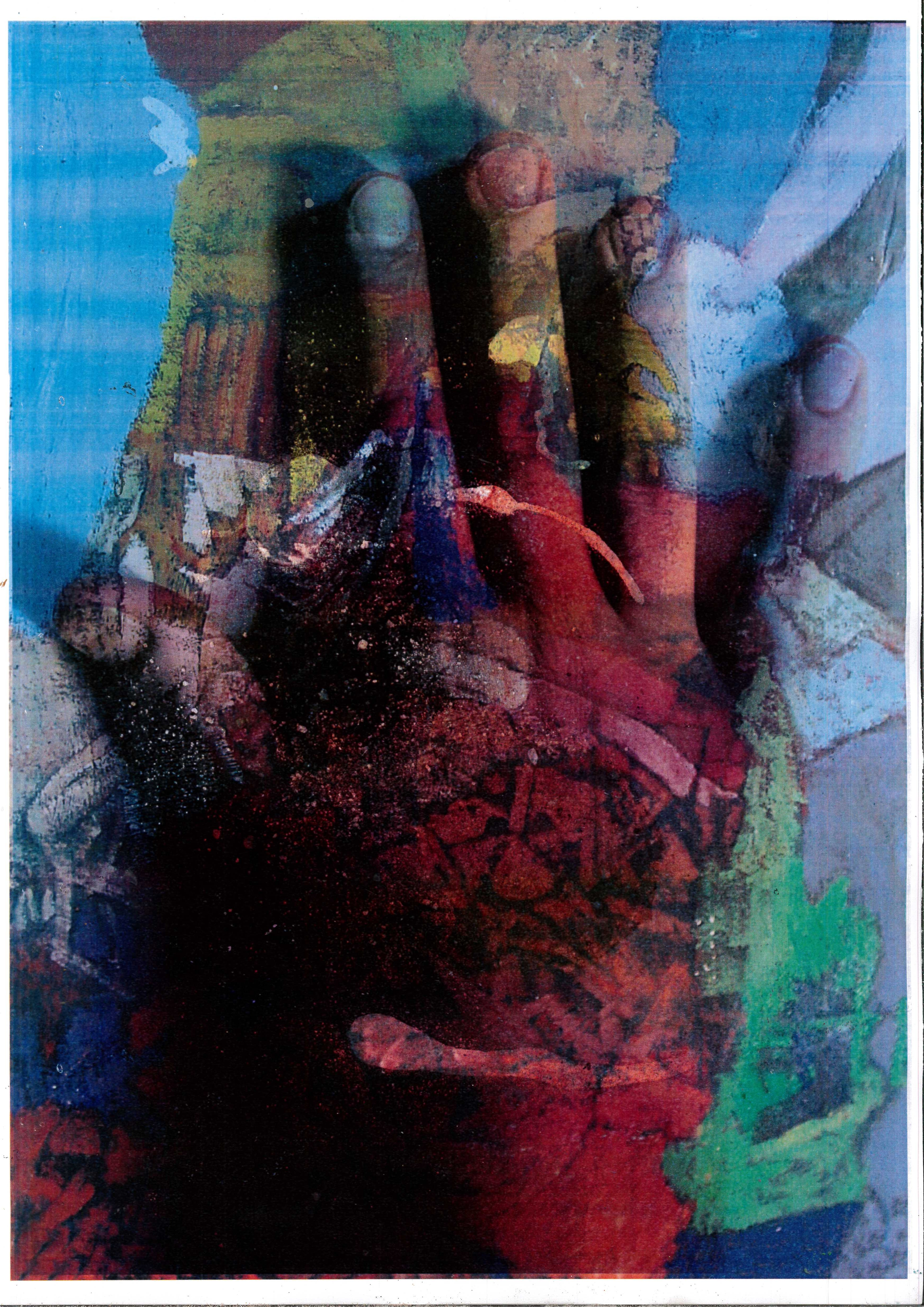
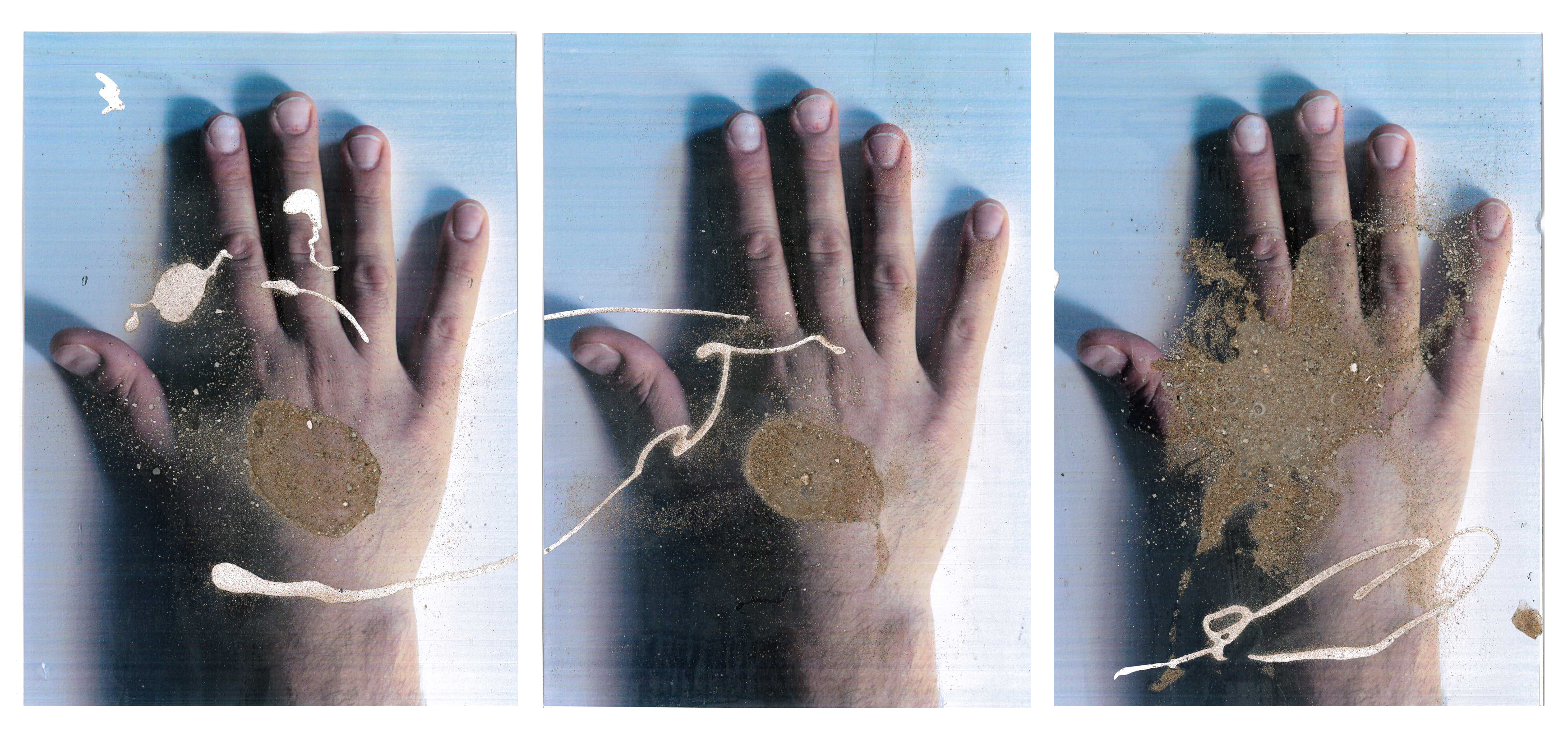
Handful of Painterly Dust.

painting turning into dust
Encaustic and oil on primed board, projection of hand, mixed media, PVA and sand.

Everything will turn into dust, including my painterly desires and uncertainties.

This is especially true, when re evaluating the hierarchy of needs in reflection to my experiences in Haiti.

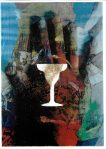
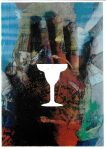
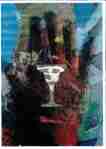
Hand gesture tries to stop a painterly process of expression and is gradually replaced by emptyness. The hole shaped as a silhouette of a wine glass, is marked with the anxieties of the past, which have turned into dust.

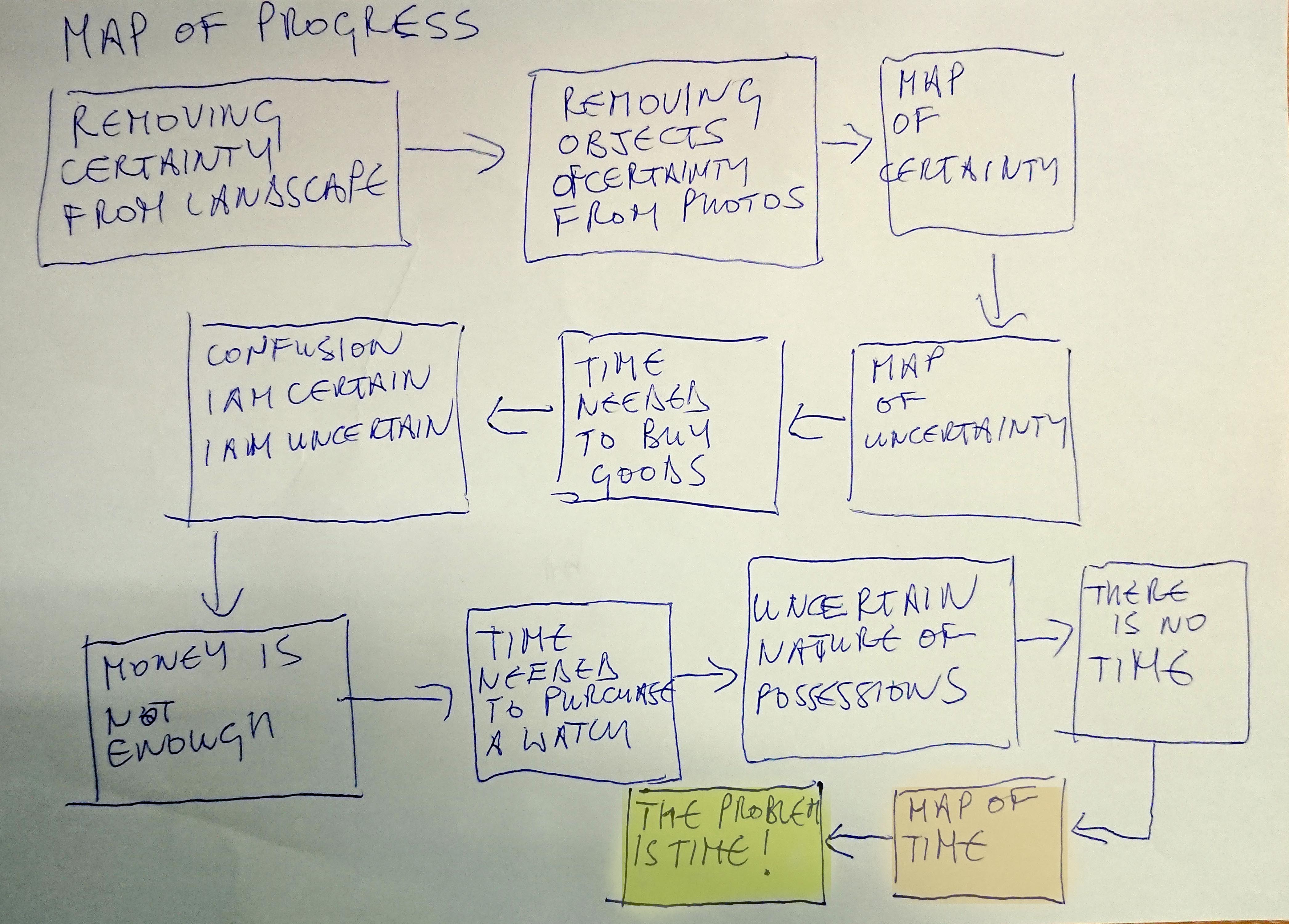
Map of Progress

Map of Progress

I have created the above map of progress to try to find out, where my research journey has taken me so far.  It should help me to get things in focus. It has also allowed me to write a list of activities, which I need to finish before moving on with additional lines of enquiry, as follows:

1. Explore references to the designs of Mr Jones watch – I need and I wantI
2. ‘I have time’ video needs to be completed and edited
3. ‘Paintings and Mirror’ video needs to be extended.

4. I have created a range of food videos and should include them in my records.

5. Check and complete a range of reflective accounts, which are currently in a note form.

6. Isolate the element of questioning, while considering the following :
What am I doing?
How can I develop it?
What is the next step?

7. Update references with research into:
Time
Chance
Change
Uncertainty

I have designed the following Map of Time.

I have time for                     I have no time for

I have time to                       I have no time to

I have time for this

This video has just been updated.  I am trying to deal with self-reflection in the mirror and the gradual replacement of focus from painting onto reflected image and vice versa.

Refinement 2.

Refinement 1.  Please, observe the inside of the mirror.

Dreaming About A Kettle

Dreaming About Bread

Dreaming About A Watch.

“Reversing the arrow of time was possible for the quantum particles because they were correlated — their properties were linked in a way that isn’t possible for larger objects, a relationship akin to quantum entanglement but not as strong. This correlation means that the particles share some information. In thermodynamics, information has physical significance”

(Conover, 2016, p. 10)

Philosophers generally agree that time is continuous as it does not stop and start or reverse.  It has also a direction and a form of order.  Therefore, time is progressive and sequential, from past to present; from present to future.  Time is also defined by its objective – the arrow of time indicates progression in only one direction – forward.

Therefore, with regards to income in Haiti, it should be possible to safe sufficient amount of money to purchase goods, which are desired and needed.  The only obstacle is …the time required for this.

Do I have sufficient time?  Is is too long to save?  Can I wait?  How much time do I need to save enough to purchase a wrist watch?

I am dreaming about a watch

2k7j63

A watch is something you have as a necessity.  It is not commonly regarded as a luxury object. Here, the aspirations are much grander, such as cars, houses, nights out and jewellery.  Therefore, the focus is on non-essential items rather than every day “things” we take for granted.

This visual consideration was inspired by a boy in a town called Jacmel.  He continuously made visual references to my basic, inexpensive watch and indicated how impressed he was with the idea of “knowing the time”.

Time, as a concept, has become a very important part of my thinking.  Therefore, if requires more contextual analysis and investigation to understand its significance in different contexts.

Everything will eventually turn into dust.  A handful of sand…

No watch
Handful of Dust

Visualising Uncertainty

Antonio Machado:

“Wanderer, your footsteps are

the path and nothing else;

wanderer, there is no path,

The path is made by walking”

(Alonso, 1980)

There are certain benefits of uncertainty.  Perhaps one the most significant advantages is “chance”.

Our obsession with uncertainty about the future can be visualised in terms of probabilities.  These are very difficult to communicate effectively outside the time typical infographics, including graphs, charts and diagrams.  The impact of Hi-Tec and interactive methods of visualisation offers totally new opportunities and can be of  substantial help here.  However, communicating deeper uncertainties remains problematic due to incomplete or disrupted knowledge and other external factors, which may affect our perception of the nature of what we are unsure of. Are we purely entertaining the feeling of being unsure?

Confidence is frequently perceived as a sign of arrogance?

This thought has led me to exploring the importance of chance and probability in the context of my response to what I feel is certain and what is not.

Contexts of certainty and uncertainty

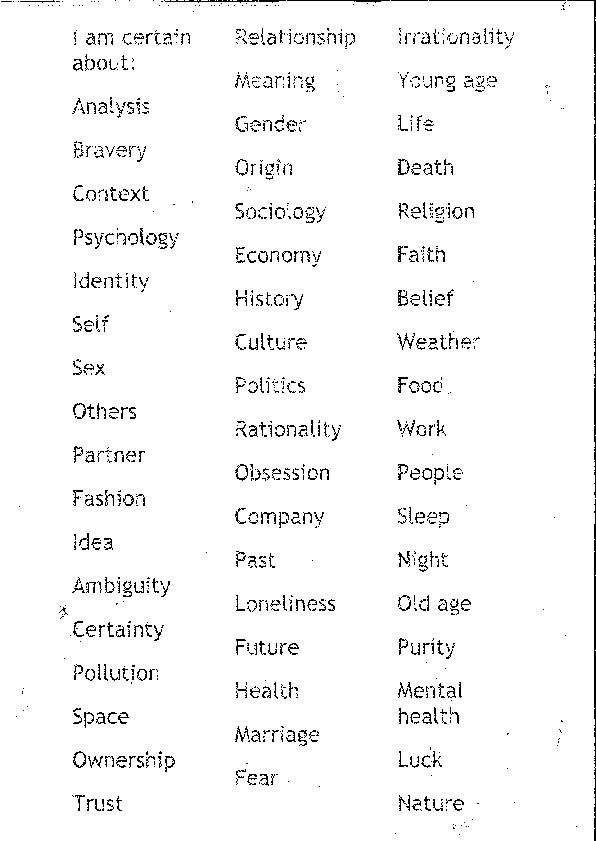
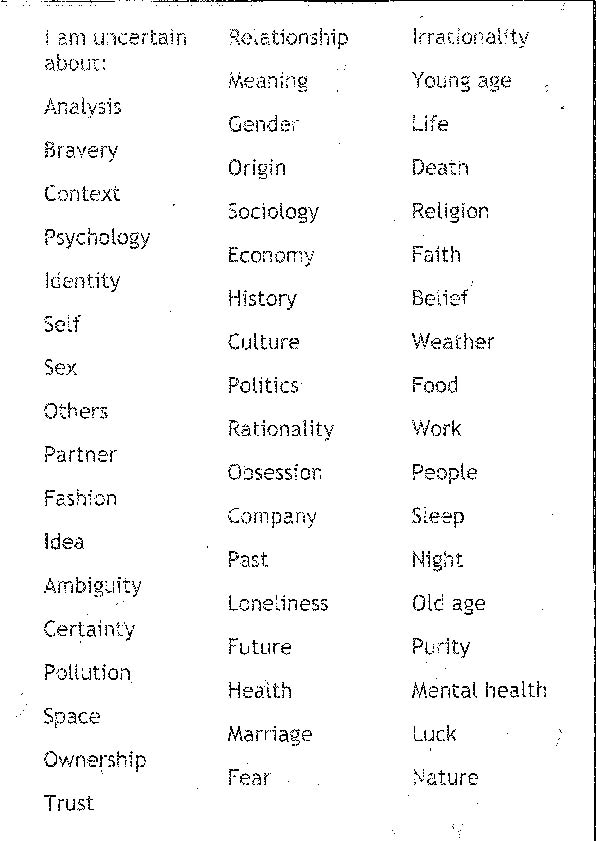
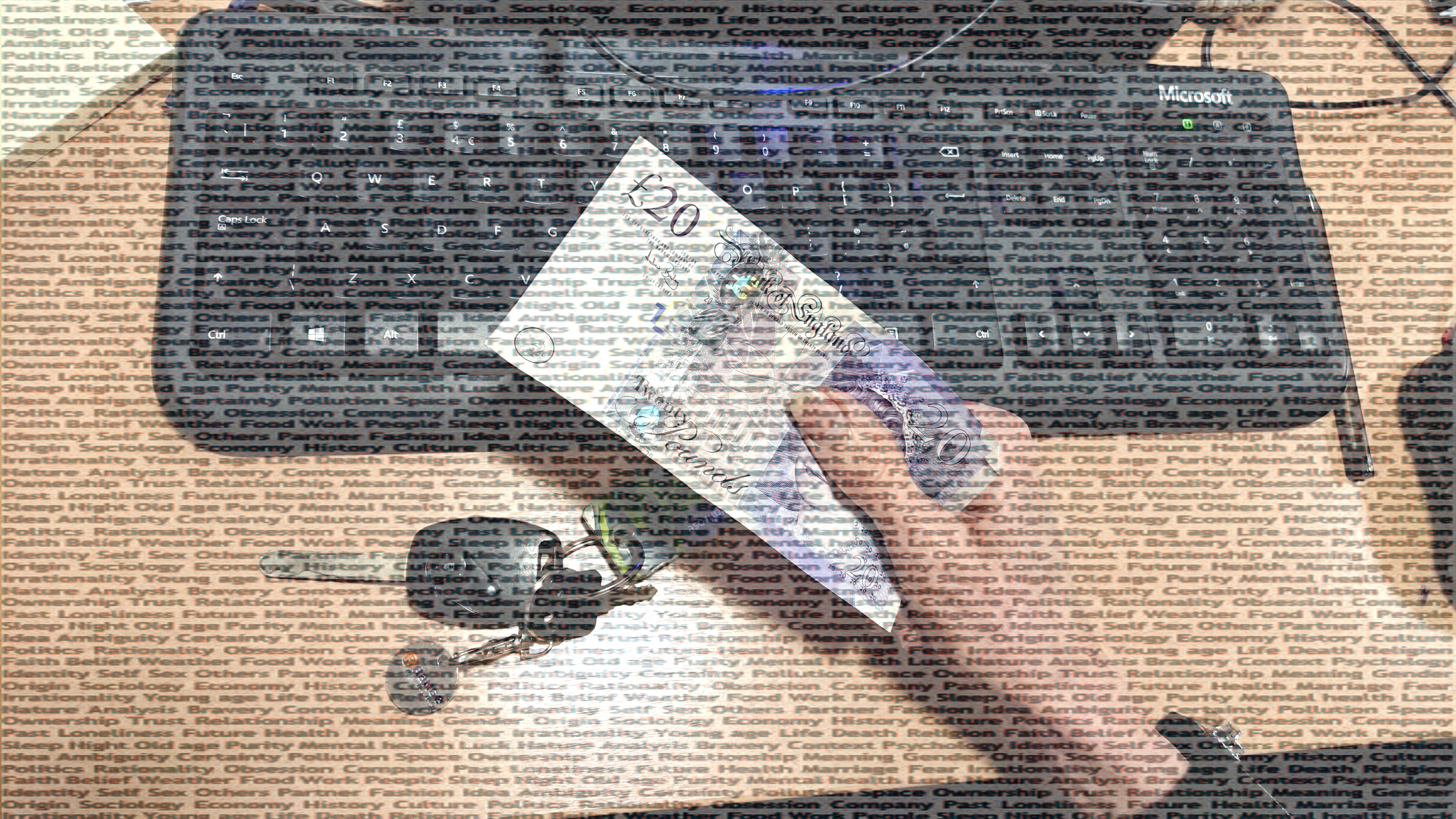
The alphabet of certainty and uncertainty.

The map of certainty and uncertainty.

certain and uncertain money

By chance, things have suddenly become much more uncertain:

How do I measure chance in all those contexts?

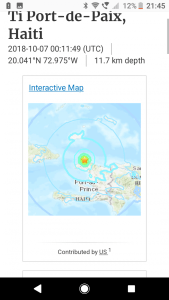
Unfortunately, Haiti was struck by another earthquake today.  All of my friends there have been affected.

What does poverty mean in the context of sustaining life?

How do I communicate the extent of uncertainties exaggerated by this natural disaster?

You Can Never Be Sure of Everything!

Making Certainty Uncertain and Unpredictability Definitive


“Uncertainty about what?

While the Heisenberg Uncertainty Principle (HUP) does not mean “there are some things you can never be sure of”, it does imply “you can never be sure of everything.” How can this be? If you can never be sure of everything, doesn’t that mean there are some things you can never be sure of? Surprisingly, no.” 

(Wiseman, 2012)

Fundamental certainties of the past have become the greatest uncertainties of the future. The most significant uncertainties of the past have evolved to become almost certain today and definitive tomorrow.

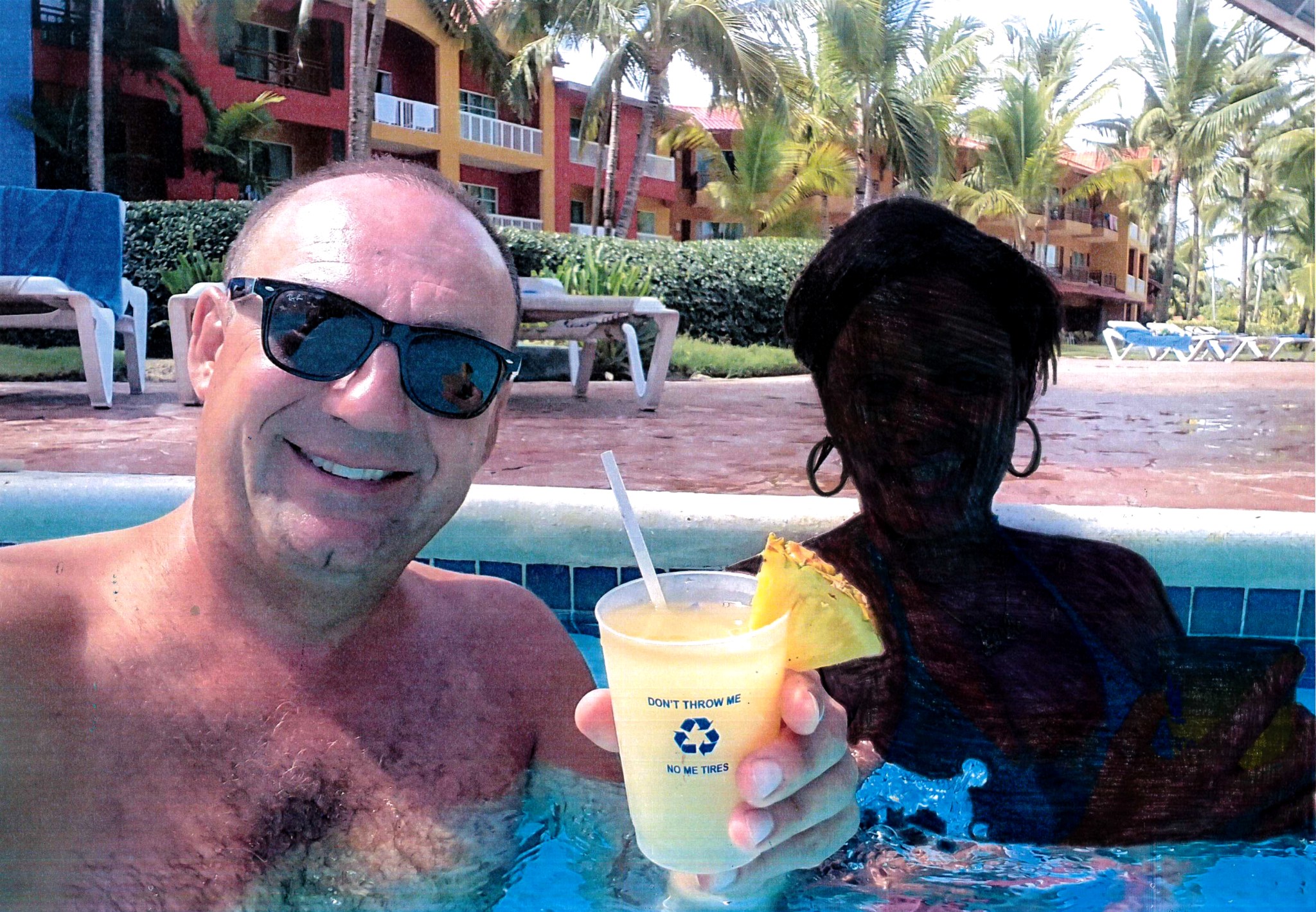
In reflection to my experiences in Haiti, I am experimenting with removing my certainties from the certainly uncertain world there!  Through these image manipulations, I am questioning what is uncertain?  Can the removal of certainty create anxiety of unpredictability?

My certainties are their uncertainties!  I am certain of having a meal and they are never sure of what will happen; what to expect – moment after moment, day after day, year after year.

The world of certainties is totally denied to some unfortunate people, both physically, emotionally and in the sphere of dreams, aspirations and ambitions.  Their focus of poverty is completely different, placed on survival rather than luxuries and unnecessary commodities.  This is in contrast to the superficial and trivial obsessions of the “Western World”!

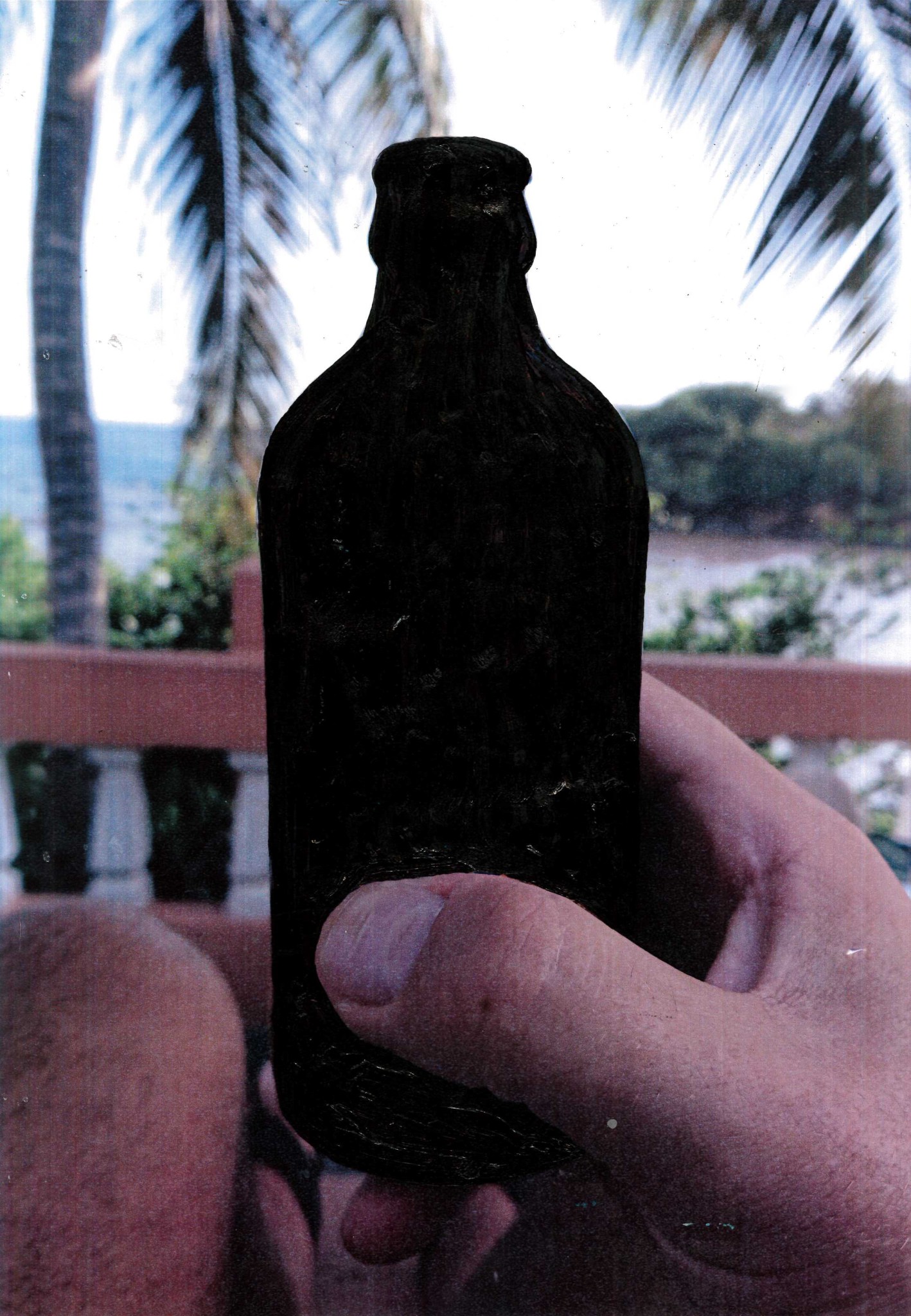
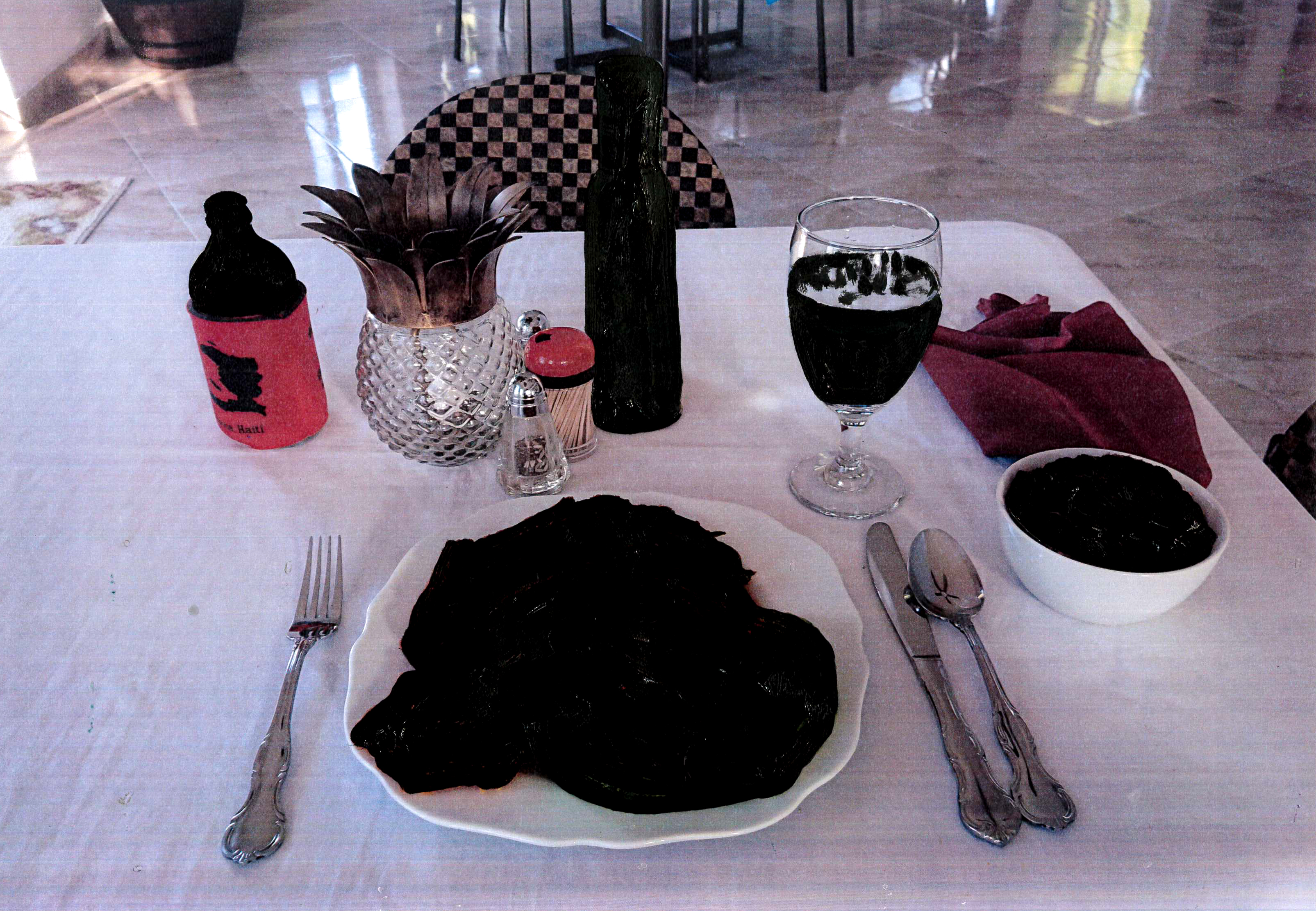
I am watching their uncertain world through the “removed” certainty on my afternoon beer.

incertain beer

I am staring with uncertainty at the certainty of my luxury meal.  The table is set up and ready, but the food has been removed.  What is on my plate, in the bowl?  How am I going to satisfy my hunger for security and thirst for predictability?

uncertain meal2
uncertain holiday

Everett argues that we live in a Universe of multiple space-times and each spacetime is governed by Lorenz contraction of time (Barrett, 2011). Therefore time is perhaps the key factor, which forms our perception of certainty and uncertainty.  Both feelings belong to parallel yet distinctly different worlds: prosperity and poverty; the arrogance of confidence and hesitant insecurity.

Heisenberg implies that uncertainty is often a result of a measurement (Wiseman, 2012). The act of measuring an object’s position changes its speed or vice versa. Perhaps the real origin is much deeper.  The uncertainty principle exists, because everything in the Universe behaves as a particle and a wave at the same time.  In quantum mechanics, the exact position and speed of an object have no meaning.

To explore this idea further and visualise this concept, I need to experiment with images by manipulating them into “behaving” simultaneously like a particle and a wave.  Particles exist in a single place at any instance in time and waves are disturbances spread out in space.

Uncertainties of Tomorrow

Removing certainty from Haitian landscape.  All elements, which can be take for granted have been covered with printing ink.

lets the story begin with “spark”…

Please, click on the link below:

https://spark.adobe.com/page/fQ9VytzHNpWq9/

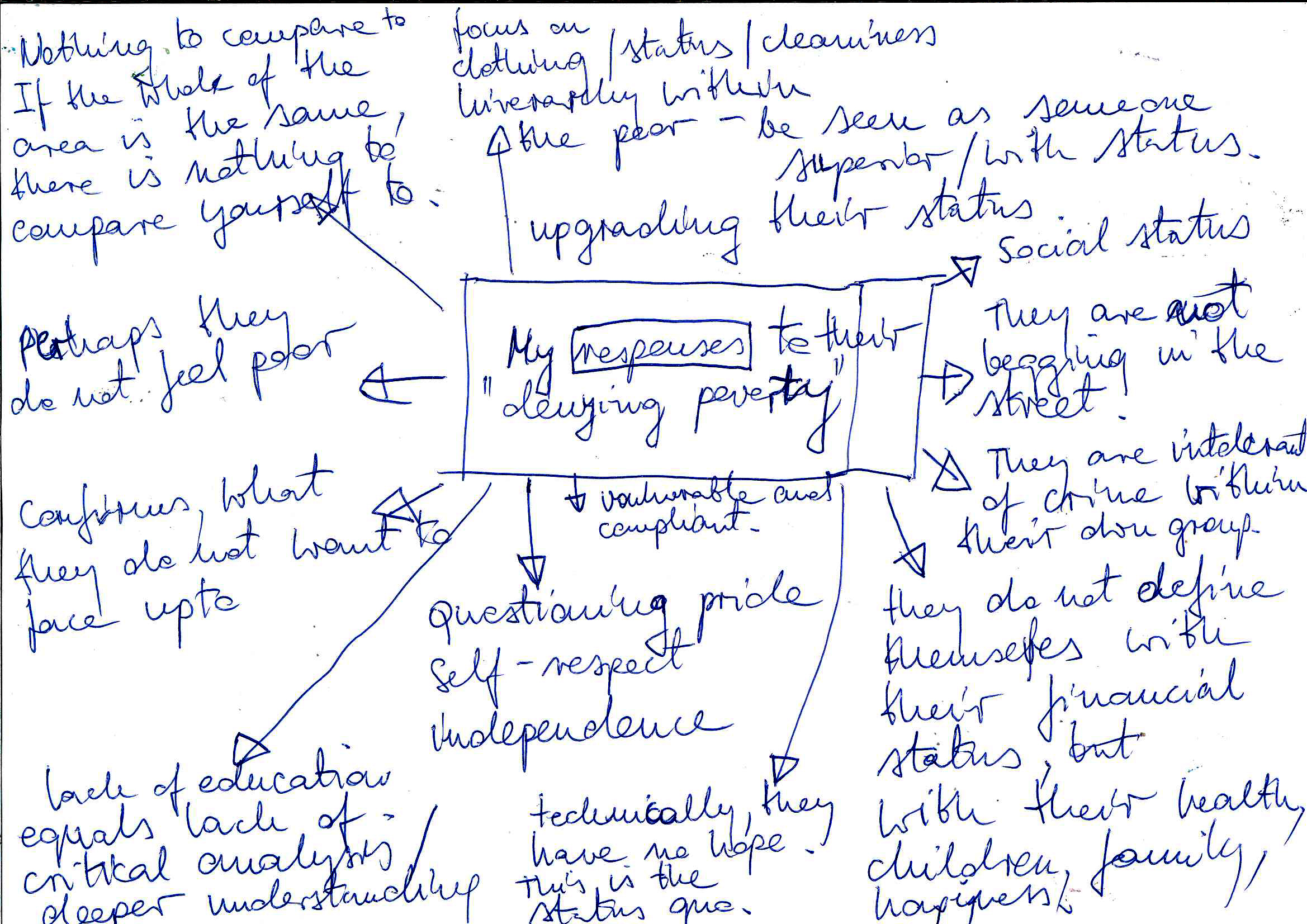
Denying poverty.

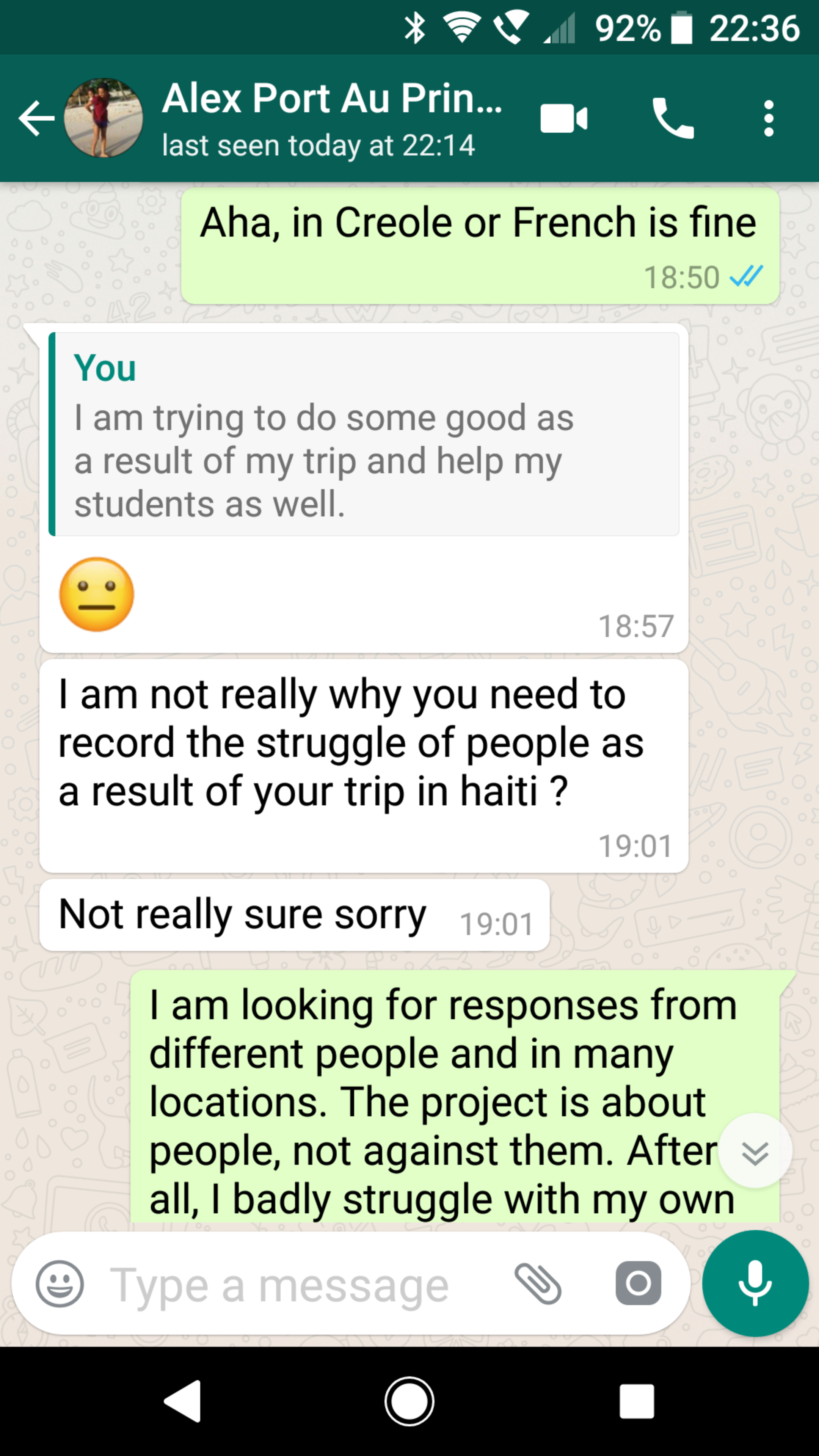
screenshot_20180906-223614

No one is prepared to accept reality. How can we embrace the idea of tomorrow if we reject the dynamics of today?

poverty brainstorm

My key responses:

Deadpan. Watching poverty with patience; knowing I can escape from it at any time.

However, can I equally escape from my own uncertainties of tomorrow?

I am becoming increasingly focused on the following  contradictory interdependence between certainty and uncertainty:

Uncertainty becomes the norm.

Certainty becomes very uncertain and sparse.

Certainty is the contemporary “gold dust”.