
Reflection on Mid-Year Review

I presented a video with supporting sound and text. A lot of thinking and consideration came into the development of my ideas in order to communicate the essence of my concept without being retrospective and descriptive of what I have done so far. I wanted to show the backbone of my current exploration, manipulation and experimentation in an ambiguous and open to interpretation way. After all, the prolonged agony of being suspended in vacuum while waiting for a very uncertain change is a multi-dimensional and complex concept to communicate.

All observing staff and students have done their best to embrace my messages, analyse them and try to formulate constructive feedback as a suggestion for further consideration and development.

I have received a variety of insightful comments and recommendations, all of which will be carefully considered in order to give “birth” to new ideas and creative possibilities for further discussions and visual dialogues.

The first and longest document was sent be Alexis. I really appreciated the time and effort he put into trying to understand and analyse my project. His words are as follows:

Pav’s work deals very much with time, time as a resource which creates a sense of anxiety and tension through inactivity and waiting. He subconsciously contrasts the act of waiting in others with impulsive actions that constantly create and destroy paintings in a continuous never-ending cycle as though in an attempt to stop the process from ending. He even has clocks counting down the flight take of times of various destinations around the world he is committed to visiting. The significance of this appears to be as filling in time by the very act of anticipation with is a mixture of apprehension and excitement, hope and fear.

I have the sense that you take passivity full on by the throat and making impulsive action your creative métier.

Q – How, as you state, does waiting imply that tomorrow will be better than today?

The video gives a pessimistic sense of waiting, uncertainty, fear, empty.

The first part of the video deals with a static state of passivity. The second part is active and almost impulsive.

Q – How do you envisage your work in the context of that sharp dichotomy between passive, imposed waiting and impulsive self activation?

When will you be coming back?———–

I don’t think Haitians will let me record them speaking about their struggle.

She offers her recordings on her own struggle.

Q – What is your response to her offer and when she says, ‘Why are you coming back so soon?’

Q – The lady conjectures on your reasons for returning, is she being polite, is she finding a polite way of saying no how do you process this event?

The lady speaking appears to be talking about the dignity of what I presume to be her compatriots. The sense comes across of your being an intruder from another set of circumstances.

Q – Are you an observer or participant in the situation, how do you deal with what appears to be an alienation from your subject,?

The monologue also implies the sense of intrusion, the sense that privacy is being intruded on for some unknown reason. This raises question about the relationship and issues of consent between artist and subject. It questions the point where being a flaneur becomes the voyeur.

Q – How does your experience inform your future approach to your practice?

The appropriation of the circumstances of others again impinges on the question of subject-observer relationship.

Does consideration of this send you in any particular direction and what form might it take?

My reflection:

My work is not about documenting a logical process of waiting for something to happen in the context of a predictable outcome. It is more about appraising the hopelessness of waiting as a bizarre non-activity. It is about an admission of a total lack of control, idea and energy for a new sense direction; a plan of how to proceed and what to do to change and improve the status quo of being. It is about uncertainty, unpredictability and fragility of life and the overall existence.

The second commentary was by Kelda:

Pav: I would like to know more about what the work at the end of the video is? What are your ideas? The apparent building up of materials that include labels from something mixed up with what looks liked messed up print or paintwork. How do these images relate to the ‘uncertainties of tomorrow’? Are you predicting a future or messing up the immediate visual space as an illustration of today? Is it deliberately ambiguous?

My reflection:

Essentially, this is my ultimate creative intention to develop work, which is ambiguous rather than illustrative and descriptive. The process is not about the “building up of materials”. It is more about an attempt to collage memories with interwoven anxieties coming from a variety of contexts; from economic to spiritual, existential to cultural and psychological to existential.

My work is based on a dialogue between the sensitive and painterly act of creation of a glimpse of hope and its subsequent destruction through the violent process of blasting it off. It is also a portrayal of hope as a failure to change anything – a total waste of time, effort and associated empty emotions.

Friederike commented:

I love how you are just sitting in that classroom. That strangeness of waiting. There is an artist you really have to look into called Ron Amir, an israelian artist, he just had an exhibtion in the Museum of modern art in Paris and filmed in refugee camps with migrants from African countries nearby. One would see these people in the state of waiting. For example longly preparing a coffee, but then nobody would come. Just waiting for something to happen that does not happen, because they are trapped.

My reflection:

I am going to consider the idea of entrapment as a manifestation of waiting. This is a new possibility worth investigating, especially in the context of my next research trip to Georgia and Azerbaijan in 19 days time.

Matt suggested the following:

Pav –

What does waiting physically and mentally involve? Waiting is difficult. Your paintings are vibrant and energetic, if still – as Ive said before im interested in the gestural aspect of the way you use the jet-wash – blasting through to reveal fragments of figurative elements, snapshots. Grasping at moments and solitude in a societal tornado. There is a time bases quality to this which calls back to the problem of waiting which I wonder about – possibly this line of inquiry could be pushed further? Id like to know more about how you feel regarding the qualities of your process and what you would identify as areas for development and focus.

My reflection:

Exploring possibilities of gesture is an exciting avenue and a possibility of project development. More precisely, it is about the contradiction of it – the absence of body language. Discussion of waiting as a state of suspension, almost hibernation.

Arthur:

Also enjoyed scene sitting in classroom- wondered whether parts were frozen digitally or if people were staying still.

My reflection:

There was a small selection of my students in the video. I asked them all to stay as still as possible and remain non-responsive to any form of external stimuli and completely reaction free.

The process of digital editing using Adobe Premier allowed me to slow the element of time further by another 25% to enhance this intentional effect.

Michelle:

Pav – Each layer as you work places each piece into its own state of waiting and a feeling of anticipation develops with each layer. The process feels as important as the outcome. Really like the vibrancy of the colours and the images you use as part of each work make me imagine the rest of the scene and a narrative of what the subjects are waiting for or going to be doing next.

My reflection:

I definitively agree with a statement that the process is as important as the outcome. Perhaps, I would go even further by proposing that the process of building layers and destroying them is this only aspect of the work, which actually matters. The process is the outcome and more precisely, the meaning of the process contradicts the outcome.

Aristotle:

Pav: Beautiful, really beautiful. Gives me context of your work and your progress as well in an unconventional way. The classroom footage gives us further insight to who you are.

Paintings are very vibrant and emotionally tense at the same time. Very successful in portraying what you want them to.

The only thing that doesn’t come across is what you anticipate your future steps to be.

My reflection:

The only anticipation at this stage is to continue with the developed process while experimenting with further primary sources from Georgia and Azerbaijan to triangulate data and my research findings.

Taiyo

The video you waiting in a classroom seems very time-based. I think the work change the dimensions of time, It feels like time is slower than usual. And I’m expected to see people’s facial expression while waiting. But I doubt it was all about hope, I think sometimes people waiting is just because it’s easier than take actions.

My reflection:

This is very interesting suggestion to look at waiting as an easier option. This idea could manifest itself through a simplification of the figurative narrative and a compositional device.

AxAsh

Pav Szymanski

I think the ’suspension’ in your video works really well. I like the control of the speed of the video, but maybe you can add more contrast between the slow part and the fast one. I like that you invited different people to speak in the video, which is a really good way to show that a state of waiting is a collective situation.

My response:

Seeing the state of waiting is definitively a collective phenomenon. We are all waiting for something. It can be very important and life-changing or simply insignificant in the grander scheme of works. What is important here is the anticipation, emotions and butterflies in the stomach. Who knows, what will actually happen…

Mid Year Review of Current Practice – Final Refinement

Please, watch the final version of my video below.  The initial black screen is intentional and there is supporting sound throughout. Thanks.

My project is an attempt to create a metaphorical and exploratory portrayal of people, who are trapped in the state of waiting. This ‘suspension’ is usually associated with a bizarre uncertainty and developed by a range of discrepancies between what is expected, desired, anticipated and what actually happens.  In essence, it is about HOPE!

The unpredictable character of life and its uncertain quality make our existence very delicate and fragile. Our anxieties can be camouflaged by money, entertainment and other temporary disruptions. However, waiting in the context of uncertainties of tomorrow is the foundation of what I am trying to explore and visualise in a series of painterly interpretations.

The complexity of the element of questioning in the project was increased by my experiences and observations in Haiti. I recorded memories of desperate people, who waited for something to happen, not really knowing, who and what they were actually waiting for.  Waiting therefore, has become a form of being while suspended in vacuum – a contemporary manifestation of our existence.

It also reinforces the universal value of critical analysis of the phenomenon of waiting, which is critiqued, discussed and conveyed in the ‘Theatre of Absurd’ novel titled “Waiting for Godot” by Samuel Beckett.

“(Vladimir) Why are we here, that is the question? And we are blessed in this, that we happen to know the answer. Yes, in this immense confusion one thing alone is clear. We are waiting for Godot to come. …We are not saints, but we have kept our appointment.”


Beckett, S (1953) Waiting for Godot in

https://www.thoughtco.com/waiting-for-godot-quotes-741824

Low Res – Seeing Collaboration Project. Day 1

This was a true ice breaking exercise, which allowed to erase boundaries between the online group and London based students.  The other benefits included integration of year 1 and 2 students, and most importantly, the project gave everyone an opportunity to expand their horizons and become much more experimental in the development of ideas and discussions of alternatives.  Ultimately, we all become much more sensitive in terms of our observations of the Universe and the attention to fine details.

Following numerous consultations, my group settled on an in-depth investigation of our current individual practices to make the project very experimental. Our creative intention was to develop a broad range of ideas rather than focus on a visual proposal for finalisation.

This proved to work very well and everyone made a valuable contribution to the dialogue of contradictory perspectives and the element of questioning of visual possibilities and their meaning. This process was supported be appropriate enquiring discussions and evidence of critical analysis.

All collaborative participants presented their research findings at the end of the day. We were the only group to remain open minded and approached the task with a truly experimental attitude; focusing on the reflective process rather than on illustrating the narrative.


A combination of group efforts put together on Padlet.


There are some action shots from the Low Res collaborative day project – Seeing.


Mid Point Review – First Draft.

My project is an attempt to create a metaphorical and exploratory portrayal of people, who are trapped in the state of waiting. This ‘suspension’ is usually associated with a bizarre uncertainty brought about by a range of discrepancies between what is expected, desired, anticipated and what actually happens.  In essence, it is about HOPE!

The unpredictable character of life and its uncertain quality make our existence very delicate and fragile. Our anxieties can be camouflaged by money, entertainment and other temporary disruptions. However, waiting in the context of uncertainties of tomorrow is the foundation of what I am trying to explore and visualise in a series of painterly interpretations.

The complexity of the element of questioning in the project was increased by my experiences and observations in Haiti. I recorded memories of desperate people, who waited for something to happen, not really knowing, who and what they were actually waiting for.

This reinforces the universal value of critical analysis conveyed in the ‘Theatre of Absurd’ novel titled “Waiting for Godot” by Samuel Beckett.

“(Vladimir) Why are we here, that is the question? And we are blessed in this, that we happen to know the answer. Yes, in this immense confusion one thing alone is clear. We are waiting for Godot to come. …We are not saints, but we have kept our appointment.”


Beckett, S (1953) Waiting for Godot in

https://www.thoughtco.com/waiting-for-godot-quotes-741824

Fragile Little Dreams Turning Orange

I was on a totally overcrowded coach in Haiti. All seats were broken, ripped and absolutely filthy.   I left early in the morning and with passing time, the refreshing sunrise breeze was replaced by a stinking stench of old sweat and … alcohol fumes.  I was travelling from La Caye to an unpronounceable and mysterious road junction (as noted by a woman in my hotel) hoping to catch a connecting minibus to Jacmel. The day was extremely hot and humid.  The bus was stuck in a traffic jam in scorching heat for over an hour. I kept looking through a dirty window to try to relax in this very claustrophobic and uncomfortable situation.  My attention was drawn to the minibus on my right. There was a young girl staring at me through the window.  She was expressionless, almost deadpan.  The hot sun created an orange glare on the surface of the glass. Her face was somehow integrated with a number of layers of reflections of the surrounding area – mainly bustling traffic.

She was sat there, waiting with patience, stone-faced and humble. I smiled and took a quick and discrete photo of the bus and her.  My fellow travelers got really disturbed by this; annoyed and angry.  They did not understand my intentions. They definitely did not like seeing a tourist photographing their hardship. I realised that by displaying an expensive mobile phone to take this supposedly meaningless photograph humiliated the locals.  It created an unnecessary division between them and I. It also reinforced our differences and  the diametrically opposite sides of life and the world. However, all this had made no impression on the girl whatsoever.  She remained untouched and unmoved, with exactly the same expression on her face.  I begun to plan ideas for a painting.  The same evening, I started to draw and make notes in my little pad. I really wanted to protect my memories from being forgotten before I return to my studio and translate my observations into a painterly interpretation.

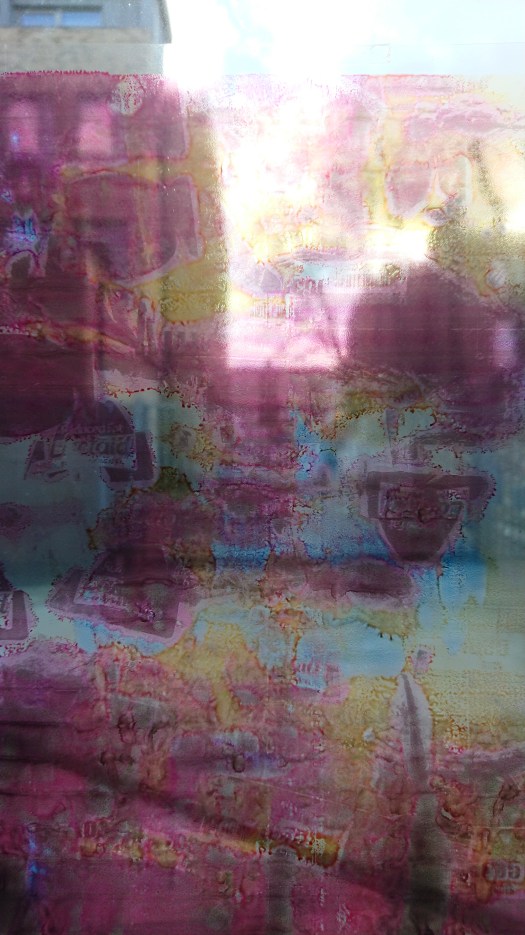
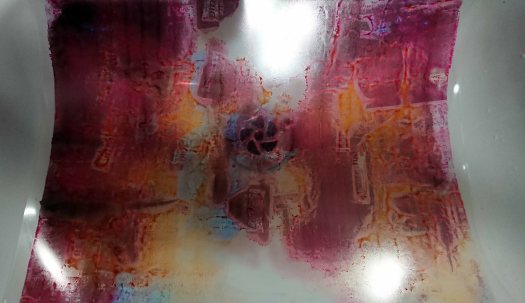
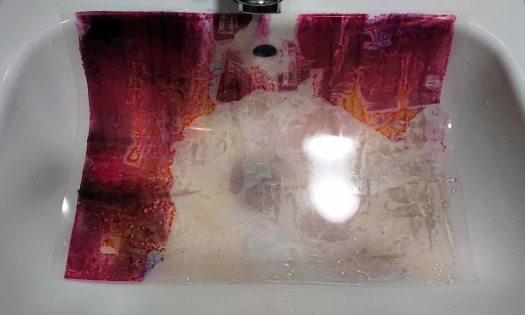
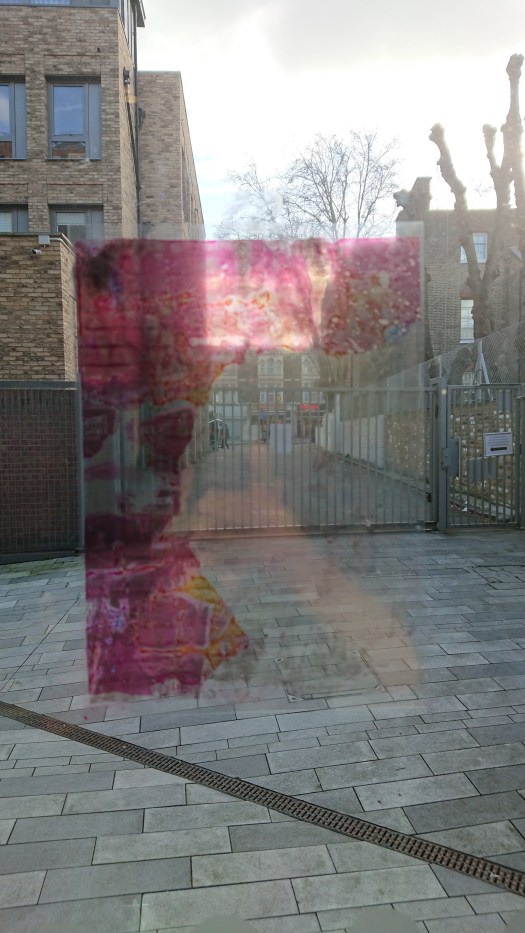
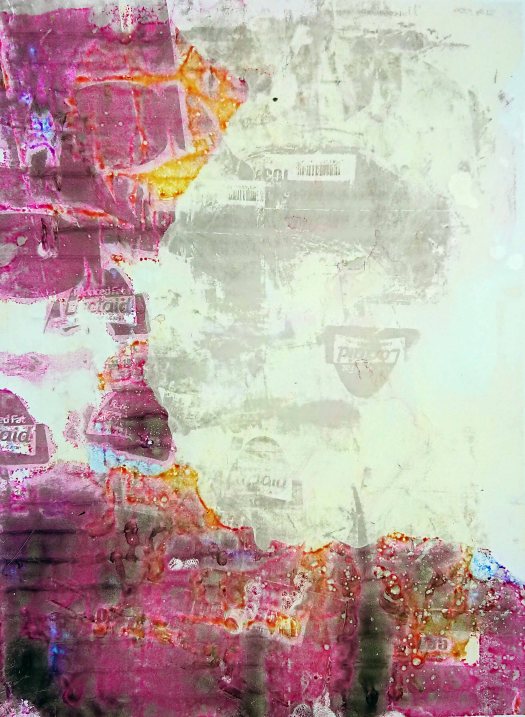
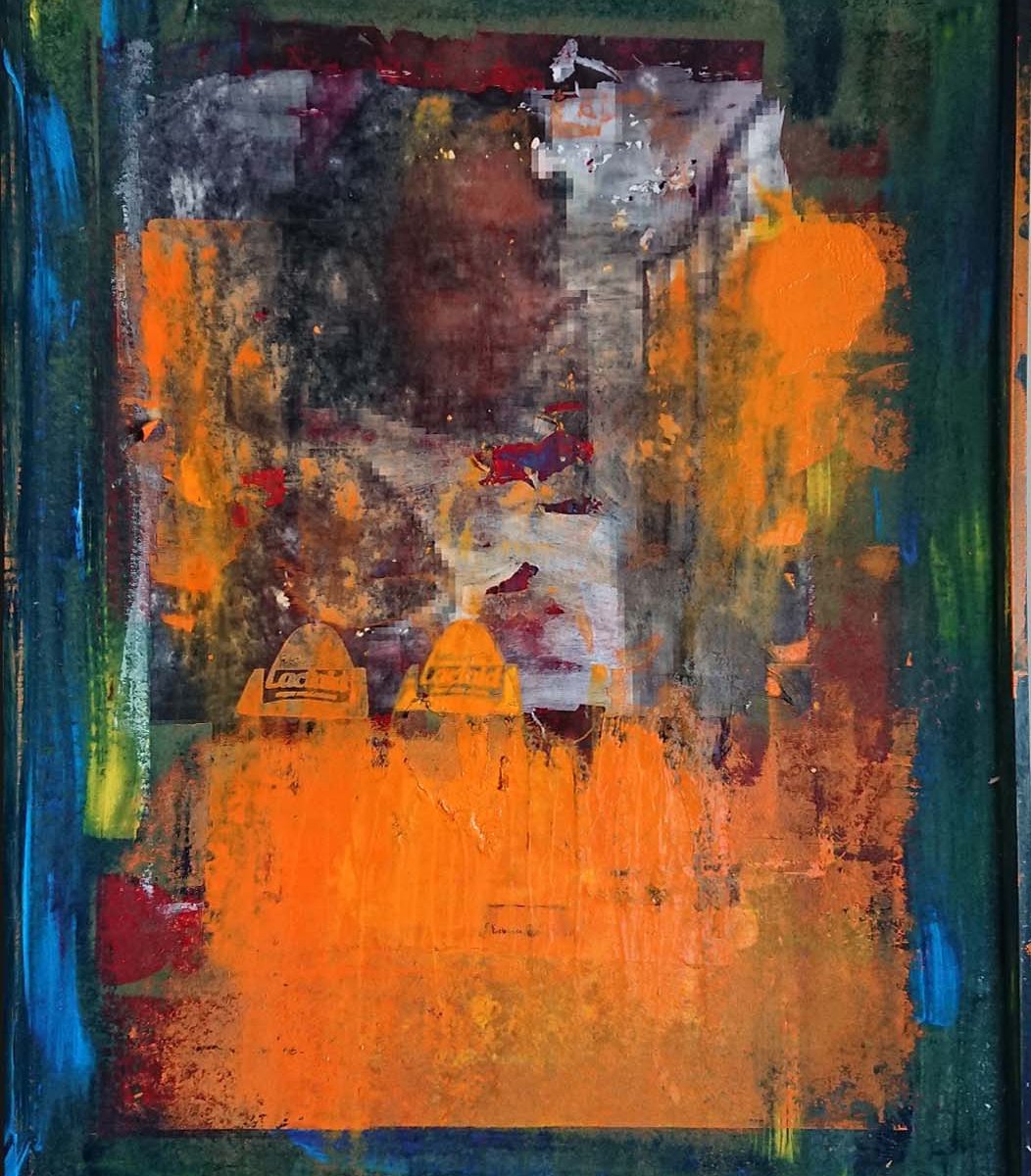
I have worked on this image for quite a while now.  Following a long process of change and manipulation, I have just blasted the red layer off and started to over-print the surface with a range of hot and creamy oranges.  These new layers have been also partially washed off to reveal little parts of the under image.  My intention was to create an ultimate superimposure of the many components and elements of this composition.

We are all waiting for something to happen, from little and insignificant things to big and pivotal changes.  As a matter of fact, we spend our entire lives waiting for the end of a journey – the final stop. Our destination is unknown and unpredictable.  This causes a lot of uncertainty. We are all subjected to mortality after all.


Little Fragile Dreams.

Memories from a horrific bus journey between La Caye and Jacmel have given me ideas for another painting in this series.  Perhaps, I will reveal the background story for this piece, when I am closer to its completion.

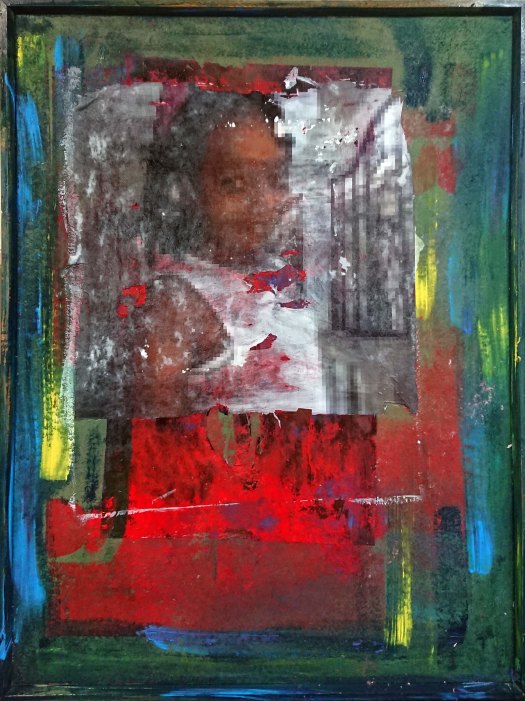
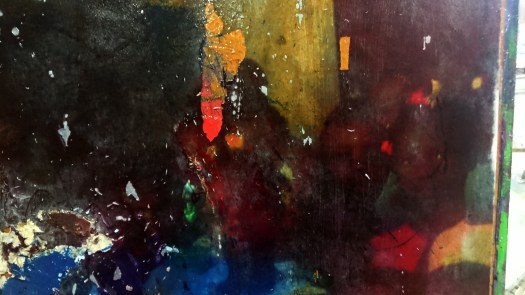
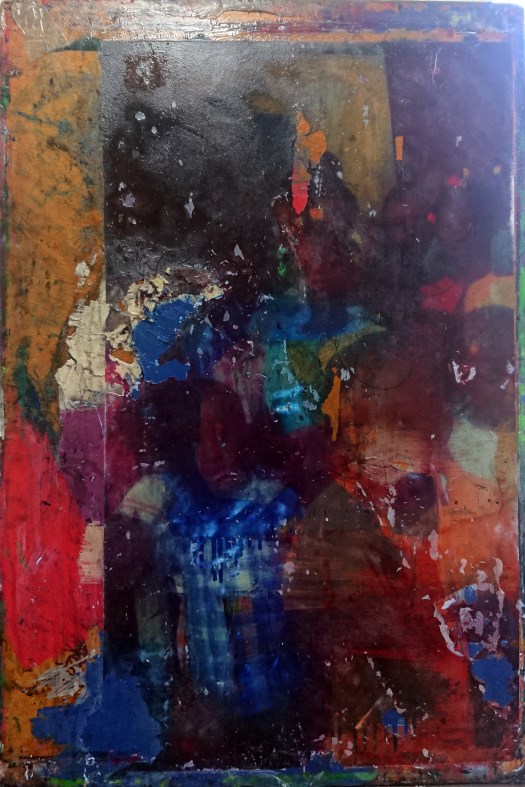
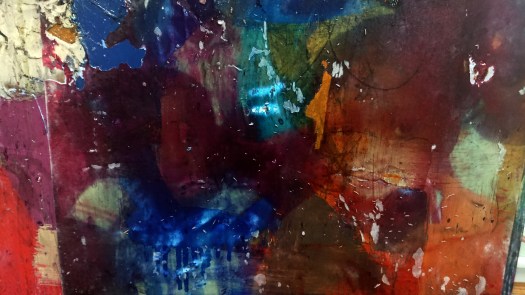
I have initiated the process by working on an under image.  This was then combined with a range of over layers and an ambiguous reflection of a little girl seen through a bus window. For this type of experimentation, I have recycled an old display board, which was covered with green felt.  Subsequently, I started with some expressive colour application to the underpainting.  This has been in turn over-printed with an A1 size screen of a $16 milk bottle.  This is used metaphorically and symbolises how unobtainable this everyday food product is.  I just cannot imagine never tasting milk!

The current tonation of the piece is vibrant and dramatic.  My creative intention was to create a clash between the background composition and a suggested image of a distant and emotionless child.

The next phase will involve layers of overprints, which are subsequently blasted off with a powerful water jet.  I would like to achieve a greater degree of mixing of layers and blending of individual colour ranges to increase the overall visual complexity of this piece.

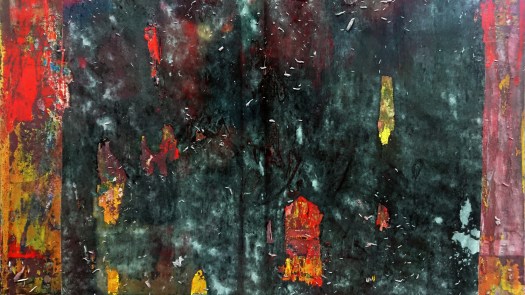
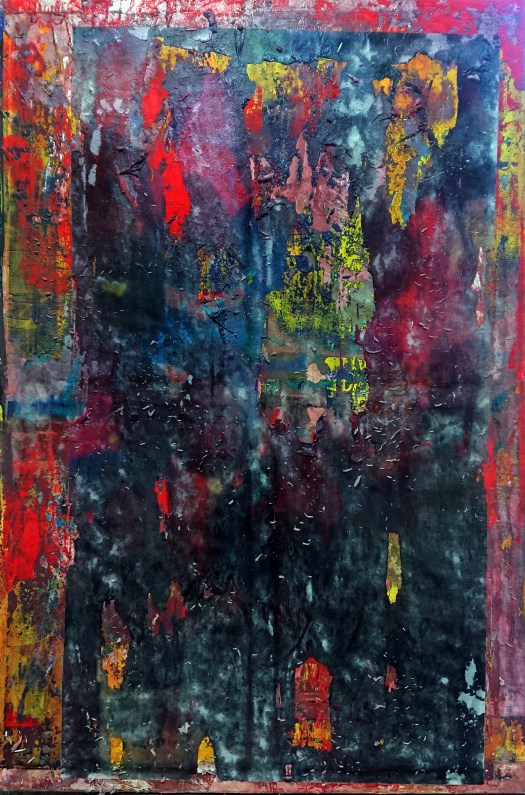
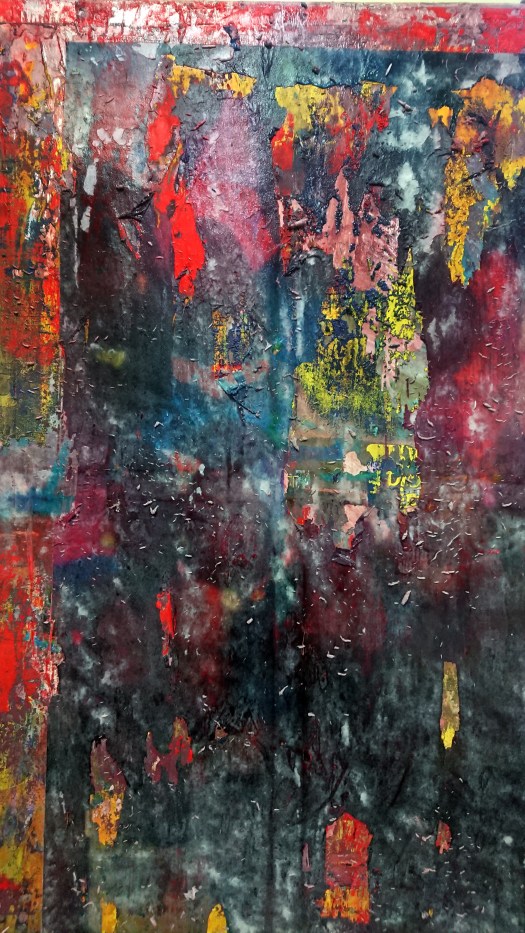
What is distracting me at the moment is the purity of colour, which stands out too much and disturbs the overall mood of the image.  I would also like to develop a greater sensitivity of colour.  This should help to make the painting more holistic and melancholic.  Perhaps, I should initiate a further experimentation with glazing and staining the image to increase the role of elements of aging and broken textures.

The image of the girl needs to behave as a distant reflection in the surface, almost with qualities of al fresco.  For some strange reason, ‘The Little Girl’ has some resemblance to Mona Lisa.  This similarity is not intentional though.

Da Vinci, (1503) “Mona Lisa” in The Independent, Farrell, J. (2017)

Ideally, I would like to develop this piece further before the start of Low Residency.

The plan is to proceed with overprinting the existing composition with a range of oranges.  This is to age and patinate the piece and, more importantly, represent powerful and distorting reflections of the hot sun in the translucent glass.

This is what I recorded in my original observations in Haiti.


DSC_0293DSC_0294


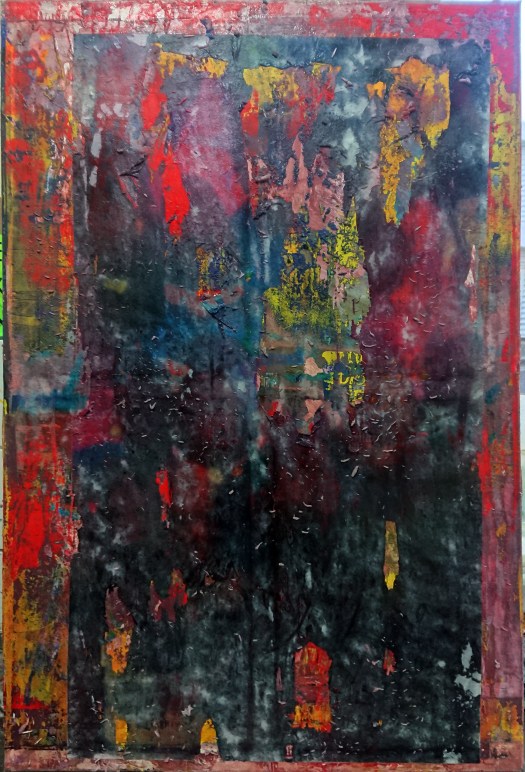
Blasting “Simply Kids”

The large, fleece covered board has not worked at all.  It soaked, bowed and twisted. Additionally, the image did not transfer well on the fluffy surface of the fabric.  I had to reevaluate and decided to use overprinting in a variety of contrasting yet harmonious colours. This has worked much better.  When I started to blast the image with a pressure washer, the ink run down to discolour the fabric and covered the hideous green frame.  I started to alternate printing with painting, image transfer, collaging cutt out photos and pasting them on top of the already complex and sophisticated surface of images and washes; all sandwiched together, coherent, layered and increasently  heavily textured.

Yesterday evening, having reflected on the painting process, I considered a range of alternatives. Through brainstorming, I developed a plan to enhance this composition with a central collage using a photo of a Haitian child.  I immediately started to overprint the existing composition before blasting it again and over again.

I am so intrigued by the complexity of this process and the value of the accidental mark, which can be achieved through this type of experimental printmaking. I continue to search for visual sensitivity, which is valued and treasured.

Ultimately, my creative intention is to communicate that we are all waiting for change, for this special moment , which has the potential to improve prospects for the future.

Noone wants to be uncertain of tomorrow.

Certainty is much more valued and treasured! Certainty is secure and safe.

Does it exist though?


Begging Children

The main concept, which I am attempting to explore and communicate is the idea of hope.  A glimpse of excitement, which has the possibility of changing everything.  It is not really important, if it results in an improvement or a decline.  The change itself  is of value here, as the presence and the past have been fully rejected.

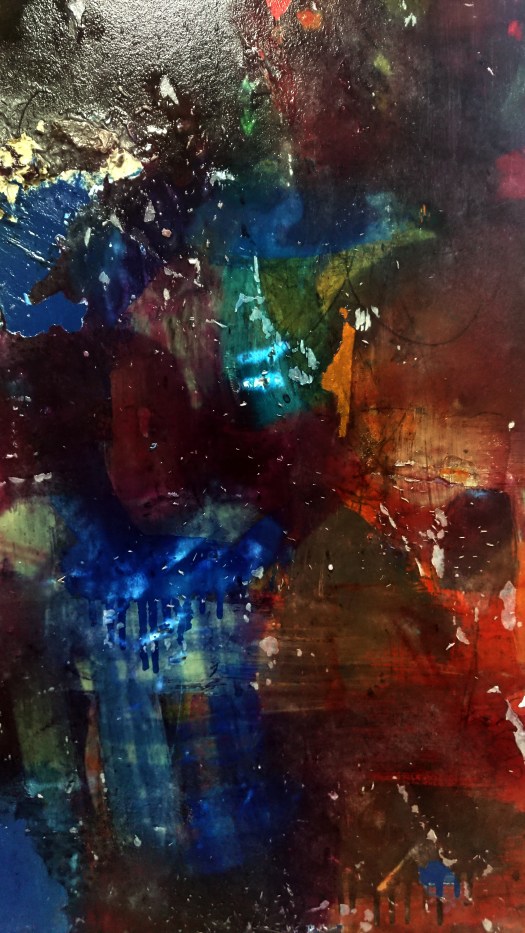
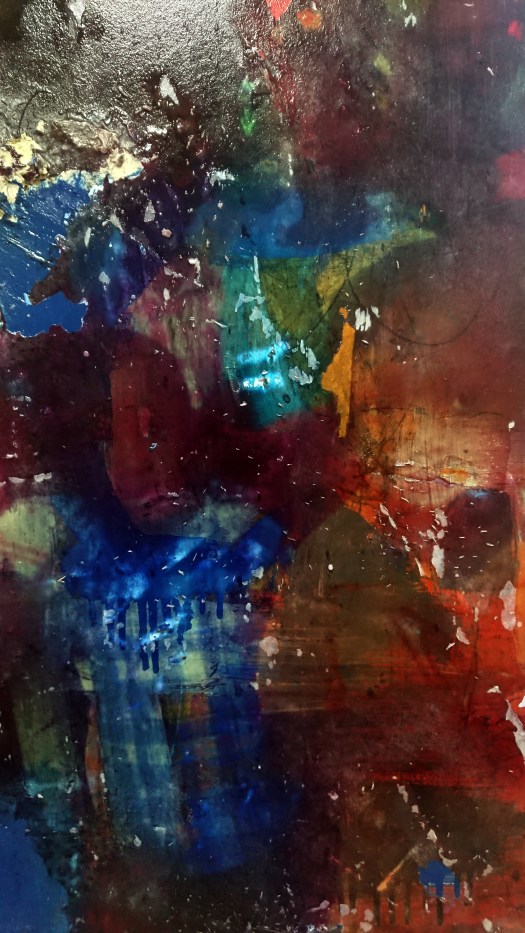
My focus is entirely placed on the depth of colour of a painterly expression and the dreamy qualities of the layers, their transparency and, almost hypnotising,  vibrancy.  Images of the children are purposefully hardly visible, hidden and camouflaged in the complexity of the composition.  They partially resemble reflections and are intended to appear ghostly.  What is also important is the breaking up and crumbling of the surface.  No-one is really certain what is out there – perhaps simply nothing.

There are reflections and sparks of light, full of secrecy and mystery, almost mystical in character. There is a wide range of bustling questions in my mind.  During the panting process my eyes have begun nervously moving around the composition without acknowledging any breathing spaces to stop and rest while trying to understand the value and meaningful the composition. The memories from Haiti have suddenly become much more vivid, intense and clear.  My heart filled with uncertainty,  nervousness and fear.

What is afoot? What will happen?  Is change imminent?

The character in my work are not here nor there…they are again suspended in the vacuum of waiting with uncertainty of tomorrow…

99988877766655544422100101102111333

Girls in Red

Following my reflection on the most recent tutorial with Jonathan, I have drawn a plan of making progress through an introduction of a variety of quality improvements.  The essence of my work is in its meaning and the visual communication of my creative intentions.

Everyone is waiting for something!!!

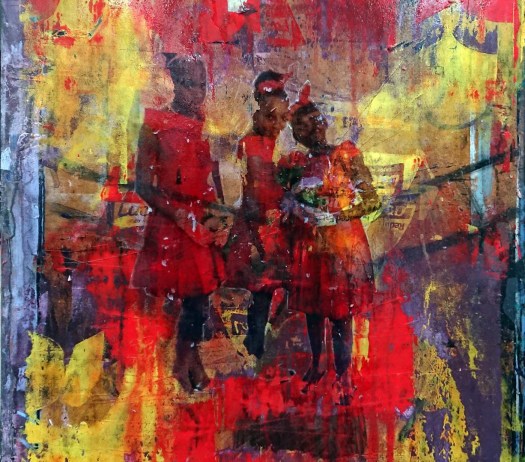
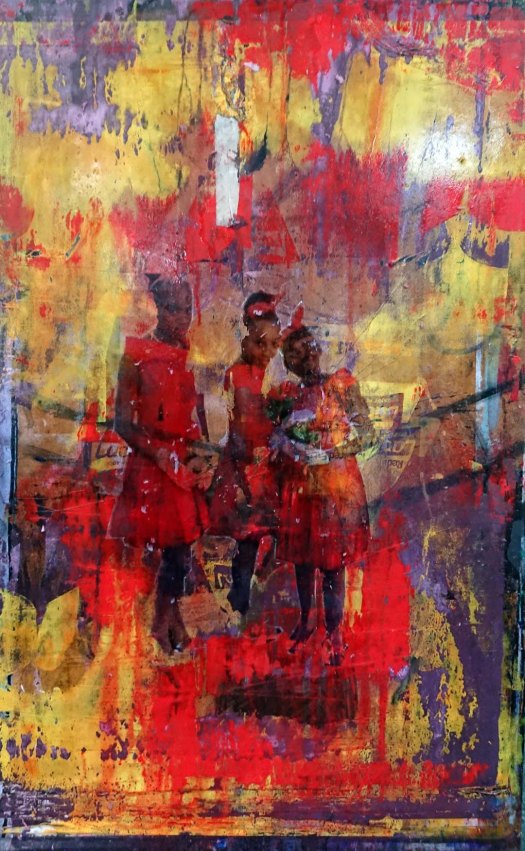
I have initiated the process of experimentation with image transfer and painting.  The intentional breaking of the overlay creates a sensitive and gentle quality through making the work feel and look more painterly.  The top layers form a very fascinating “painterly matter” and open new opportunities for further work.  I will update this post with additional developments as I progress with screen printing and blasting of images.

The other idea is to start to differentiate on the size and format of the work and explore possibilities for combining smaller images to increase the volume of the overall composition.

My main focus here was to create a sense of being “suspended in vacuum” while waiting for change. This develops a form of tension and drama.  The colour is dynamic and full of expressive turbulence. The faces of the girls are somehow twisted and deformed.  The logo element of underlay and the text, add a sense of unreality by making the composition ambiguous and opened to interpretation. The flowers, symbolic of celebration, can be used as a reward for acting as a change agent, giving hope and enabling positive prospects in life.

haiti111haiti222haiti333