Tutorial With Jonathan.

Tutorial with Jonathan Kearney

Thursday, 20th June 2019 at 9.30.  Skype call.

I have proposed a number of new ideas and possibilities for further investigation.  The main intention is to give my project a refreshed purpose and redefine my objectives. I feel that the current possibilities of using the water jet are partially repetitive and exhausted.

I have done a lot of thinking about the forthcoming trip to Burma.  I would like to use this opportunity to gather a new wealth of primary sources for further refinement and development for my project.  I am committed to the overall title: ‘Waiting.  the Uncertainties of Tomorrow.’

The key ideas are as follows:

  •  Photograph people ‘at work’ killing time and playing on their mobile phones, while waiting for the next customer.  Look for potential sources, interview and record street sellers, groups of masseurs outside parlours, beggars and touts in bus stations.
  • Research the time spent waiting for the ‘next’ customer.
  • Hanging about waiting for time to pass.
  • Waiting in anticipation versus disappointment and rejection.
  • Collect relevant fabrics and materials for future paintings.  This would increase their authenticity by adding the element of the primary truth to my work.
  • Replace the water jet with other forms of ‘washing’ images using for instance a washing machine.
  • Triangulate the data by interviewing people in a variety of contexts, the rich and the poor.

Jonathan asked me questions about the jetting process.  He was interested in the decision making process behind the blasting of paintings.  How and when do I know that this is sufficient, completed and finished?  This is a very instinctive and spontaneous response to watching my work being simply washed away.  It is born out of fear and pity to see my work disaster and simply dribble down the drain.

We followed by discussing the washing process.  Jonathan suggested that I should explore the metaphorical meaning of ‘washing’.  He added that use of a washing machine would also gives me less control over the entire process – stone washing, tie and dye, washing with chemicals or just with water, long versus short wash. Jonathan concluded that this should be a very natural process of gathering information for me.

I have completed a substantial draft of my research statement.  I have worked really hard in order to make good progress with this as most of my summer vacation will be consumed by the Myanmar field trip and associated visual research.  I expressed some anxieties about the fact that I am unsure if my work is at the required level.  Jonathan has kindly asked me to email him my current written work before next Tuesday.  I am very grateful to get this additional opportunity to receive feedback about my research statement to maximise possibilities for the successful completion of this assignment.

Following Jonathan’s suggestions, I plan to undertake a critical review of progress and blog entries at key stages of progress and development – reflection ‘in action’ and reflection ‘on action’.

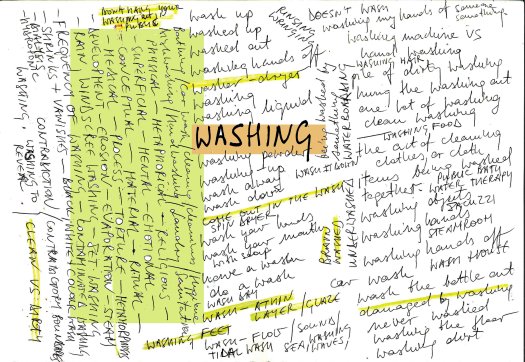
Mind-mapping of ‘WASHING’ with highlighted key ideas.

WASHING MAP


Presentations of Early Ideas for My Research Paper.

I presented my proposal for both, the title and abstract during an online chat with Jonathan Kearney and a group of 12 fellow students on Tuesday, 4th June 2019. It appeard that all my feedback came from Jonathan and Alexis, while others reminded silent.

My proposition was relatively well commented on. I have also received a number of constructive suggestions regarding looking at alternative directions of research into relevant ideas and supporting philosophy.

The key points for consideration are below:

  • Alexis – search for certainty against the acceptance of imprecision.  How will you sustain objectivity throughout your enquiry?

I am analysing uncertainty through the prism of both artefacts and supporting this investigation with a theoretical framework – Heisenberg, Russell and others.

  • Jonathan – balance the emotional response to both artefacts with a more objective exploration

Through interweaving theoretical reviews and responses to both artefacts in the light of my research findings.

  • Alexis – life is suspended in the element of chance.

I am looking at theories, which include risk, chance and belief to support my analysis of research findings.

  • Jonathan – caution, be careful , when using words such ‘universal’ and ‘complete’

My idea was to indicate a direction of my ambitions by using the word ‘more’ universal and complete.

Perhaps, I will rephrase as:

develop a more holistic and broad understanding…

  • recommendation from Alexis was to look at other philosophers, such as Schrodinger.

I am looking at both perspectives: from the traffickers to those being trafficked.

  • Jonathan – usually, the pressure is to seek the most objective position, but art is about emotion.  Therefore try to engage with the emotional side of such works.

I plan to include elements of my interpretation of these works and their impact on me without changing the tract of thought in the paper.

All in all, the feedback received and suggestions for further research were very useful in terms of broadening my horizons in preparation for the composition of the first draft of the paper.


Reflection on Mid-Year Review

I presented a video with supporting sound and text. A lot of thinking and consideration came into the development of my ideas in order to communicate the essence of my concept without being retrospective and descriptive of what I have done so far. I wanted to show the backbone of my current exploration, manipulation and experimentation in an ambiguous and open to interpretation way. After all, the prolonged agony of being suspended in vacuum while waiting for a very uncertain change is a multi-dimensional and complex concept to communicate.

All observing staff and students have done their best to embrace my messages, analyse them and try to formulate constructive feedback as a suggestion for further consideration and development.

I have received a variety of insightful comments and recommendations, all of which will be carefully considered in order to give “birth” to new ideas and creative possibilities for further discussions and visual dialogues.

The first and longest document was sent be Alexis. I really appreciated the time and effort he put into trying to understand and analyse my project. His words are as follows:

Pav’s work deals very much with time, time as a resource which creates a sense of anxiety and tension through inactivity and waiting. He subconsciously contrasts the act of waiting in others with impulsive actions that constantly create and destroy paintings in a continuous never-ending cycle as though in an attempt to stop the process from ending. He even has clocks counting down the flight take of times of various destinations around the world he is committed to visiting. The significance of this appears to be as filling in time by the very act of anticipation with is a mixture of apprehension and excitement, hope and fear.

I have the sense that you take passivity full on by the throat and making impulsive action your creative métier.

Q – How, as you state, does waiting imply that tomorrow will be better than today?

The video gives a pessimistic sense of waiting, uncertainty, fear, empty.

The first part of the video deals with a static state of passivity. The second part is active and almost impulsive.

Q – How do you envisage your work in the context of that sharp dichotomy between passive, imposed waiting and impulsive self activation?

When will you be coming back?———–

I don’t think Haitians will let me record them speaking about their struggle.

She offers her recordings on her own struggle.

Q – What is your response to her offer and when she says, ‘Why are you coming back so soon?’

Q – The lady conjectures on your reasons for returning, is she being polite, is she finding a polite way of saying no how do you process this event?

The lady speaking appears to be talking about the dignity of what I presume to be her compatriots. The sense comes across of your being an intruder from another set of circumstances.

Q – Are you an observer or participant in the situation, how do you deal with what appears to be an alienation from your subject,?

The monologue also implies the sense of intrusion, the sense that privacy is being intruded on for some unknown reason. This raises question about the relationship and issues of consent between artist and subject. It questions the point where being a flaneur becomes the voyeur.

Q – How does your experience inform your future approach to your practice?

The appropriation of the circumstances of others again impinges on the question of subject-observer relationship.

Does consideration of this send you in any particular direction and what form might it take?

My reflection:

My work is not about documenting a logical process of waiting for something to happen in the context of a predictable outcome. It is more about appraising the hopelessness of waiting as a bizarre non-activity. It is about an admission of a total lack of control, idea and energy for a new sense direction; a plan of how to proceed and what to do to change and improve the status quo of being. It is about uncertainty, unpredictability and fragility of life and the overall existence.

The second commentary was by Kelda:

Pav: I would like to know more about what the work at the end of the video is? What are your ideas? The apparent building up of materials that include labels from something mixed up with what looks liked messed up print or paintwork. How do these images relate to the ‘uncertainties of tomorrow’? Are you predicting a future or messing up the immediate visual space as an illustration of today? Is it deliberately ambiguous?

My reflection:

Essentially, this is my ultimate creative intention to develop work, which is ambiguous rather than illustrative and descriptive. The process is not about the “building up of materials”. It is more about an attempt to collage memories with interwoven anxieties coming from a variety of contexts; from economic to spiritual, existential to cultural and psychological to existential.

My work is based on a dialogue between the sensitive and painterly act of creation of a glimpse of hope and its subsequent destruction through the violent process of blasting it off. It is also a portrayal of hope as a failure to change anything – a total waste of time, effort and associated empty emotions.

Friederike commented:

I love how you are just sitting in that classroom. That strangeness of waiting. There is an artist you really have to look into called Ron Amir, an israelian artist, he just had an exhibtion in the Museum of modern art in Paris and filmed in refugee camps with migrants from African countries nearby. One would see these people in the state of waiting. For example longly preparing a coffee, but then nobody would come. Just waiting for something to happen that does not happen, because they are trapped.

My reflection:

I am going to consider the idea of entrapment as a manifestation of waiting. This is a new possibility worth investigating, especially in the context of my next research trip to Georgia and Azerbaijan in 19 days time.

Matt suggested the following:

Pav –

What does waiting physically and mentally involve? Waiting is difficult. Your paintings are vibrant and energetic, if still – as Ive said before im interested in the gestural aspect of the way you use the jet-wash – blasting through to reveal fragments of figurative elements, snapshots. Grasping at moments and solitude in a societal tornado. There is a time bases quality to this which calls back to the problem of waiting which I wonder about – possibly this line of inquiry could be pushed further? Id like to know more about how you feel regarding the qualities of your process and what you would identify as areas for development and focus.

My reflection:

Exploring possibilities of gesture is an exciting avenue and a possibility of project development. More precisely, it is about the contradiction of it – the absence of body language. Discussion of waiting as a state of suspension, almost hibernation.

Arthur:

Also enjoyed scene sitting in classroom- wondered whether parts were frozen digitally or if people were staying still.

My reflection:

There was a small selection of my students in the video. I asked them all to stay as still as possible and remain non-responsive to any form of external stimuli and completely reaction free.

The process of digital editing using Adobe Premier allowed me to slow the element of time further by another 25% to enhance this intentional effect.

Michelle:

Pav – Each layer as you work places each piece into its own state of waiting and a feeling of anticipation develops with each layer. The process feels as important as the outcome. Really like the vibrancy of the colours and the images you use as part of each work make me imagine the rest of the scene and a narrative of what the subjects are waiting for or going to be doing next.

My reflection:

I definitively agree with a statement that the process is as important as the outcome. Perhaps, I would go even further by proposing that the process of building layers and destroying them is this only aspect of the work, which actually matters. The process is the outcome and more precisely, the meaning of the process contradicts the outcome.

Aristotle:

Pav: Beautiful, really beautiful. Gives me context of your work and your progress as well in an unconventional way. The classroom footage gives us further insight to who you are.

Paintings are very vibrant and emotionally tense at the same time. Very successful in portraying what you want them to.

The only thing that doesn’t come across is what you anticipate your future steps to be.

My reflection:

The only anticipation at this stage is to continue with the developed process while experimenting with further primary sources from Georgia and Azerbaijan to triangulate data and my research findings.

Taiyo

The video you waiting in a classroom seems very time-based. I think the work change the dimensions of time, It feels like time is slower than usual. And I’m expected to see people’s facial expression while waiting. But I doubt it was all about hope, I think sometimes people waiting is just because it’s easier than take actions.

My reflection:

This is very interesting suggestion to look at waiting as an easier option. This idea could manifest itself through a simplification of the figurative narrative and a compositional device.

AxAsh

Pav Szymanski

I think the ’suspension’ in your video works really well. I like the control of the speed of the video, but maybe you can add more contrast between the slow part and the fast one. I like that you invited different people to speak in the video, which is a really good way to show that a state of waiting is a collective situation.

My response:

Seeing the state of waiting is definitively a collective phenomenon. We are all waiting for something. It can be very important and life-changing or simply insignificant in the grander scheme of works. What is important here is the anticipation, emotions and butterflies in the stomach. Who knows, what will actually happen…
Low Res Tutorial Presentations

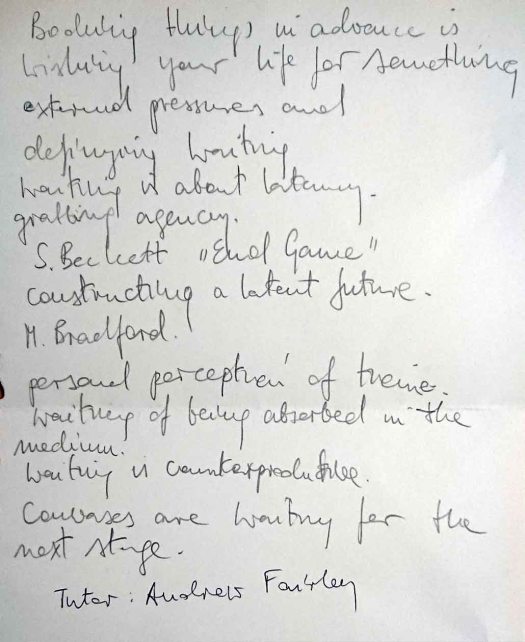
Tutor: Andrew Fairley

10.00 – 13.00 in the main studio.

Individual presentations in a group of 4 students and tutor.

I presented a prepared earlier mid-year review video.  This was supported by a background commentary to enhance the overall level of understanding of my creative intentions.  The piece is designed to start with a black screen to communicate ideas of waiting and anticipation with a note of controversy.  This is followed by a recording of a group of art students waiting in their studio environment for an inspiration.  They are all saturated in boredom and appear to be almost hypnotised by this stagnant state.

The next part of the presentation included a stop frame animation of a survey of my students depicting their most precious dreams, aspirations and desires.

The final part of the video was made of a collage of still and moving images of my recent work and experiments, which I have developed so far.

The response from group was generally positive and supportive.  I was asked a number of exploratory questions about the context of my research journey and experimentation.  We have had an in-depth discussion trying to analyse the concept of my project and discuss a number of possible alternative directions.

My key reflections are as follows:

  • waiting is counterproductive
  • waiting can mean wishing your life away
  • personal perceptions of time differ and depend on circumstances
  • waiting frequently occurs because of external pressures
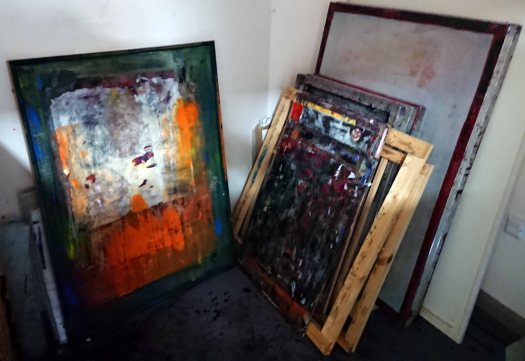
  • my work is developed simultaneously.  Individual pieces are metaphorically and physically waiting for the next stage of the creative process.  This is recorded by a photo below:

8EBAE64C-873E-4C90-B65F-7D3A1FDF13E8

  • I discussed my reflections on Samuel Beckett’s “Waiting for Godot”.  It was also recommended for me to read his other novel titled “End Game”.

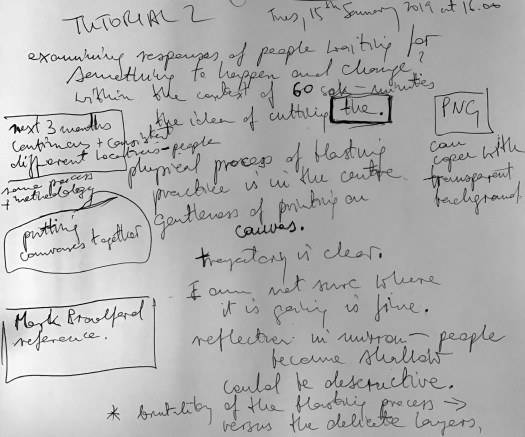
My rough notes taken during the tutorial are below:

tutorial

Tutorial 2

Tutorial with Jonathan Kearney on Tuesday, 16th January 2019 at 4 p.m.

64fcc337-3b6f-49cf-878d-951ff2971455Issues discussed:

Jonathan has helped me to regain focus on what I am trying to explore during an hour-long video call on Skype.  When discussing my individual ideas, his particular attention was drawn to the brutality of the process of blasting of images in contrast to the sensitivity and gentleness of individual layers achieved.  Jonathan emphasised the value of this type of experimentation and reinforced the importance of the creative practice in visual research:

“the physical process of blasting images is in the centre of your research and practice”.

(Kearney, J. 2019)

He also suggested that my trajectory was clear and a degree of hesitance and uncertainty of direction is very much a part of the overall process of risk-taking and visual experimentation.

The option of transferring images onto reflective surfaces was discussed and partially rejected.  This is due to the destructive aspect of the behaviour of the audience in the context of this type of interaction. The attention of a viewer could be placed firmly on their “look” and impression in the mirror rather than the intended reflection on the meaning of the work.

My immediate work plan is to continue with the process of blasting images and over-layering  them using screen printing, painting and image transfer.  The portfolio of my primary sources will be triangulated and extended during the planned trip to Georgia and Azerbaijan in April, and Thailand and Burma in July and August 2019.  I will also consider using sources from my local environment.

The principle of the working process and methodology will remain the same.

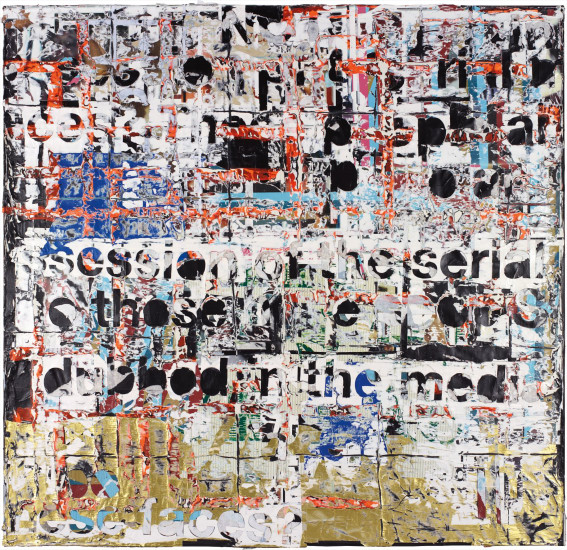
It was also recommended to look at the work of Mark Bradford.  His unique collages and paintings on paper possess an organic quality and are frequently based on a grid-like composition. The surface of his work has got a highly textured, layered and almost typographic quality, making references to the dynamism of a metropolitan landscape.

This is supported by the bleeding of colour and layering.

Mark-making and painterly gestures are also very important elements in the overall work – all making a contribution to the painterly process.

Related image

Mark Bradford
B.1961
SPEAK, BIRDMAN
signed on the reverse
mixed media on canvas
59 1/2 by 70 1/2 in. 151.1 by 179.1 by cm.
Executed in 2018.

Image result for mark bradford

MARK BRADFORD

Rat Catcher of Hamelin III

mixed media on canvas
304.8 x 320 cm (120 x 125 7/8 in.)
Executed in 2011.

Tutorial 1

Tutor: Jonathan Kearney

30th October 2018 at 4 p.m.

Issues discussed:

Initial progress and direction of project and experimentation.

Jonathan asked a lot of probing questions and used the Socratic approach to establish a good grasp of what was my line of questioning.  We soon developed a good working rapport and his supportive commentary allowed me to open up and reflect on and isolate the essence of what I was trying to communicate.  It soon become very apparent that my explorations were broad-ranging.  I was also prepared to look for alternatives and discuss them through painting, photography and film, while taking risks and trying to develop a deeper understanding of my creative intentions.  My current focus, however, remains on refining my concepts through broad-ranging contextualisation and extended critical analysis.

” Remain opened.  MA should give you a chance to explore other pathways at the end of the course”

Jonathan Kearney

It had also become clear that I had no idea as to where my research journey was taking me and what were my expectations regarding the shape and form of the final visual proposal.  The emphasis was solely placed on the development of ideas and alternatives through prolific production of work and supported by a dialogue of contradictory perspectives.

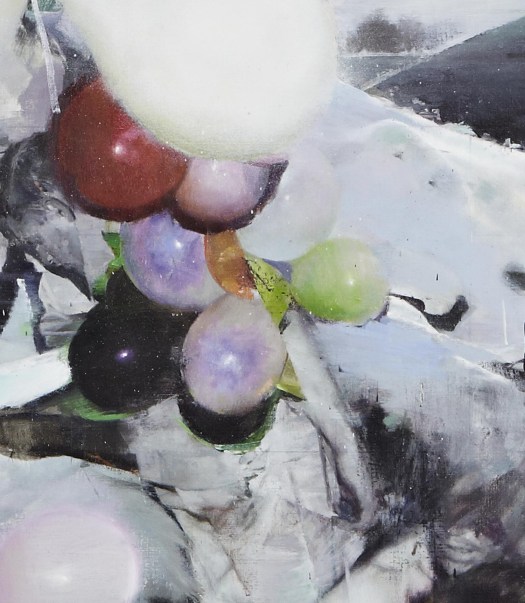
Jonathan’s skills in direct questioning of my thought processes had led to a deeper reflection on the essence of my work and helped to draw plans for introducing meaningful quality improvements.  It was suggested that I should look at the work of Justin Mortimer, especially one of his pieces titled  “Resort”,oil on canvas, 181 x 220 cm, 2012

jm resort (detail) 2012 oc 181 x 220 cm

We have discussed the juxtaposition of the contradictory subject matters.  This ambiguity creates a powerful line of questioning,  builds curiosity and remains opened to interpretation.  Jonathan has also explained Mortimer’s multi-stage process of transformation between digital manipulations and the painterly execution.

I was very inspired by the work and decided to direct my further explorations towards looking at possibilities of visualisation in this new space for me, which is created somewhere between digital (non-physical) and the physical act of painting.

The tutorial has helped me to develop a greater understanding of my thought processes and overall research intentions.  My focus remains to be on “my own response” to poverty.  Its function is not documentary.  It is intended to be more of a self-diagnosis and reflection on my own priorities and hierarchies of needs.

“Focus of self is legitimate”.

Jonathan Kearney


Final thoughts:

“Time” as a concept remains vitally important in my research and exploration.

What is the point of this?

What is for?

Who is it for?

What do I want?

What do I need?

What do I have?