Blasting “Simply Kids”

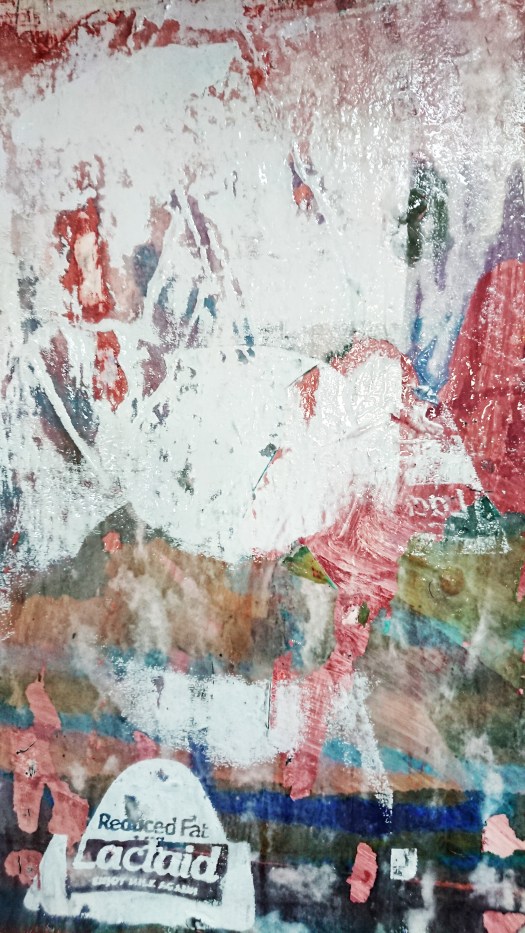
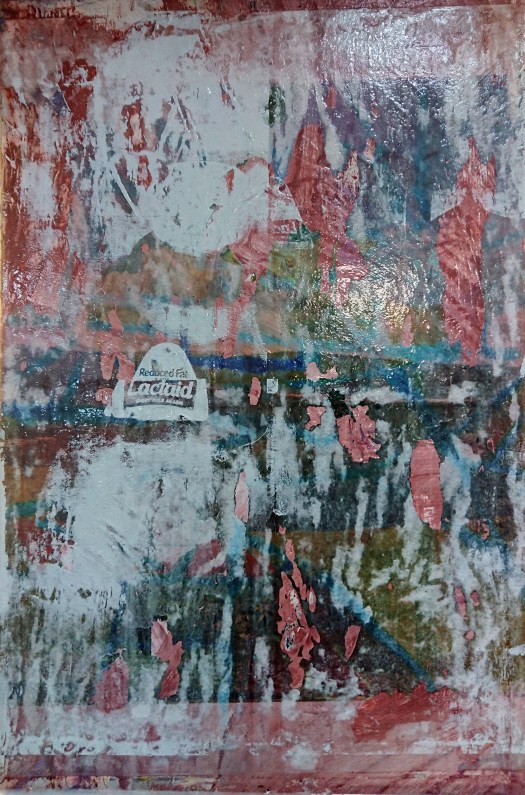
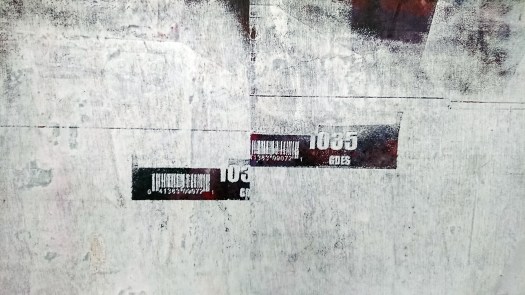
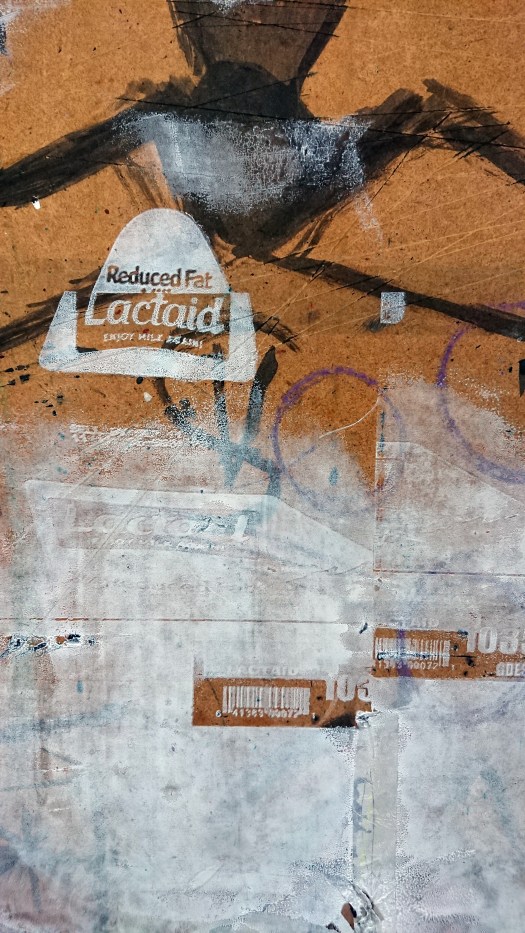
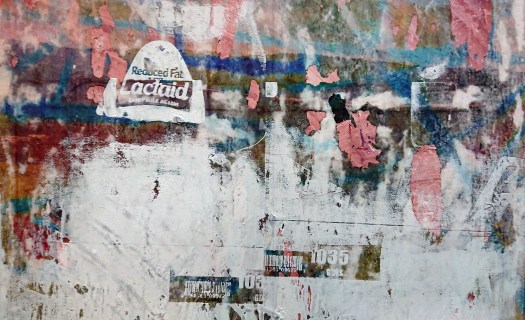
The large, fleece covered board has not worked at all.  It soaked, bowed and twisted. Additionally, the image did not transfer well on the fluffy surface of the fabric.  I had to reevaluate and decided to use overprinting in a variety of contrasting yet harmonious colours. This has worked much better.  When I started to blast the image with a pressure washer, the ink run down to discolour the fabric and covered the hideous green frame.  I started to alternate printing with painting, image transfer, collaging cutt out photos and pasting them on top of the already complex and sophisticated surface of images and washes; all sandwiched together, coherent, layered and increasently  heavily textured.

Yesterday evening, having reflected on the painting process, I considered a range of alternatives. Through brainstorming, I developed a plan to enhance this composition with a central collage using a photo of a Haitian child.  I immediately started to overprint the existing composition before blasting it again and over again.

I am so intrigued by the complexity of this process and the value of the accidental mark, which can be achieved through this type of experimental printmaking. I continue to search for visual sensitivity, which is valued and treasured.

Ultimately, my creative intention is to communicate that we are all waiting for change, for this special moment , which has the potential to improve prospects for the future.

Noone wants to be uncertain of tomorrow.

Certainty is much more valued and treasured! Certainty is secure and safe.

Does it exist though?


Blasting Red

What have I actually achieved?

This is a brilliant question.

I have started to investigate my responses to waiting for change in a very uncertain world!

The current focus of my practice is to experiment with overprinting of painted images. Subsequently, I blast the surface of newly created and layered compositions with a powerful water jet.  The partial marks, which are left after this procedure are combined with further screen overprints.

The hope of achieving a new sense of completion is simple washed away. The repetitive character of this process makes the uncertainty physically unbearable, yet visually exciting. How far can I push this process? When will I reach the stage of exhaustion? What is the impact of colour on the overall effect?  How many layers become lost?

The more certain the moment of completion is the more uncertain I become about it.

I have also noticed that canvas is much more appropriate for technique than working on old wooden boards. There is more gentleness and grace to the printing on canvas and a sense of full interruction between individual layers. Perhaps, I should restart the entire process by creating further compositions using a really large format of canvas.

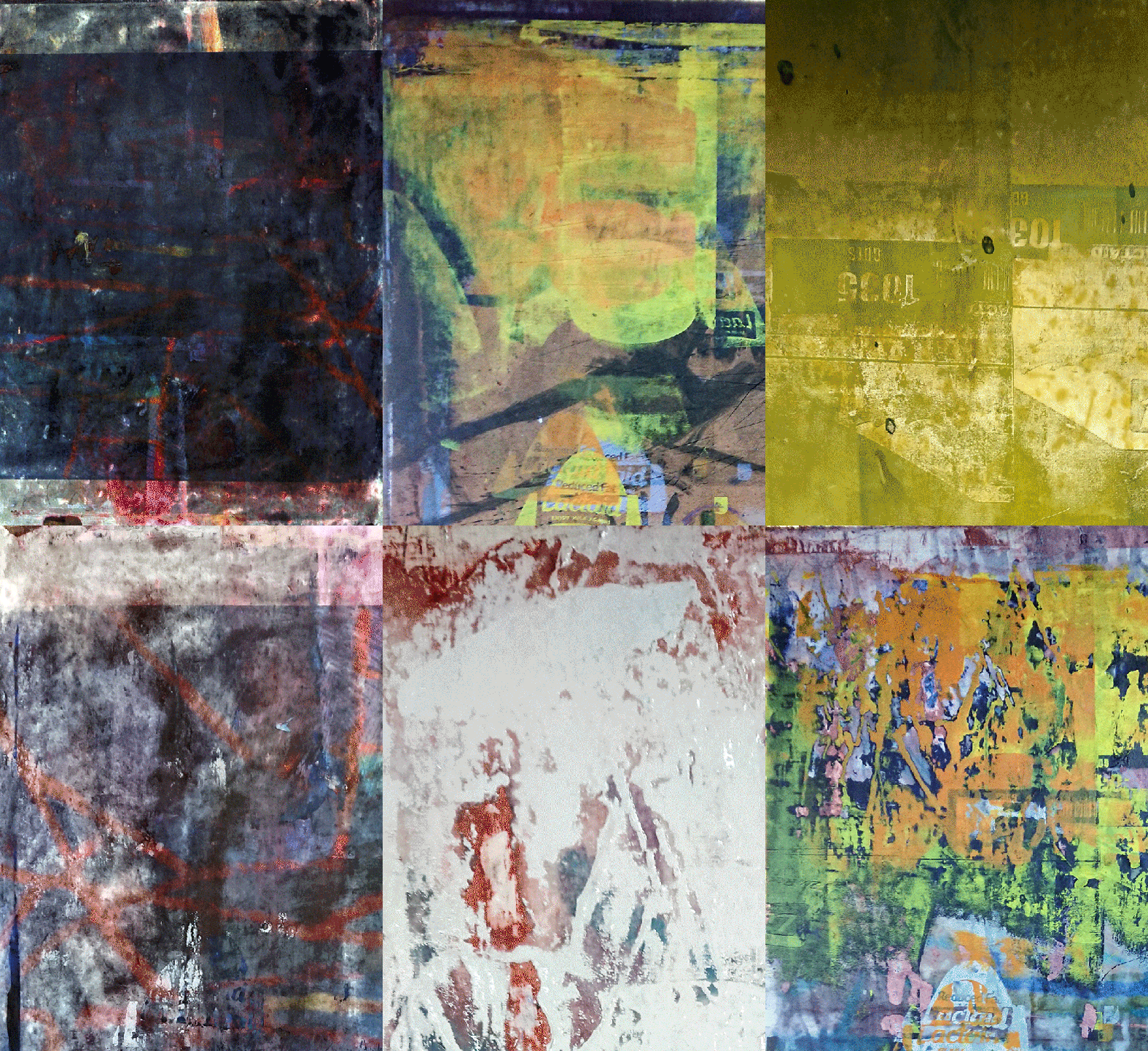
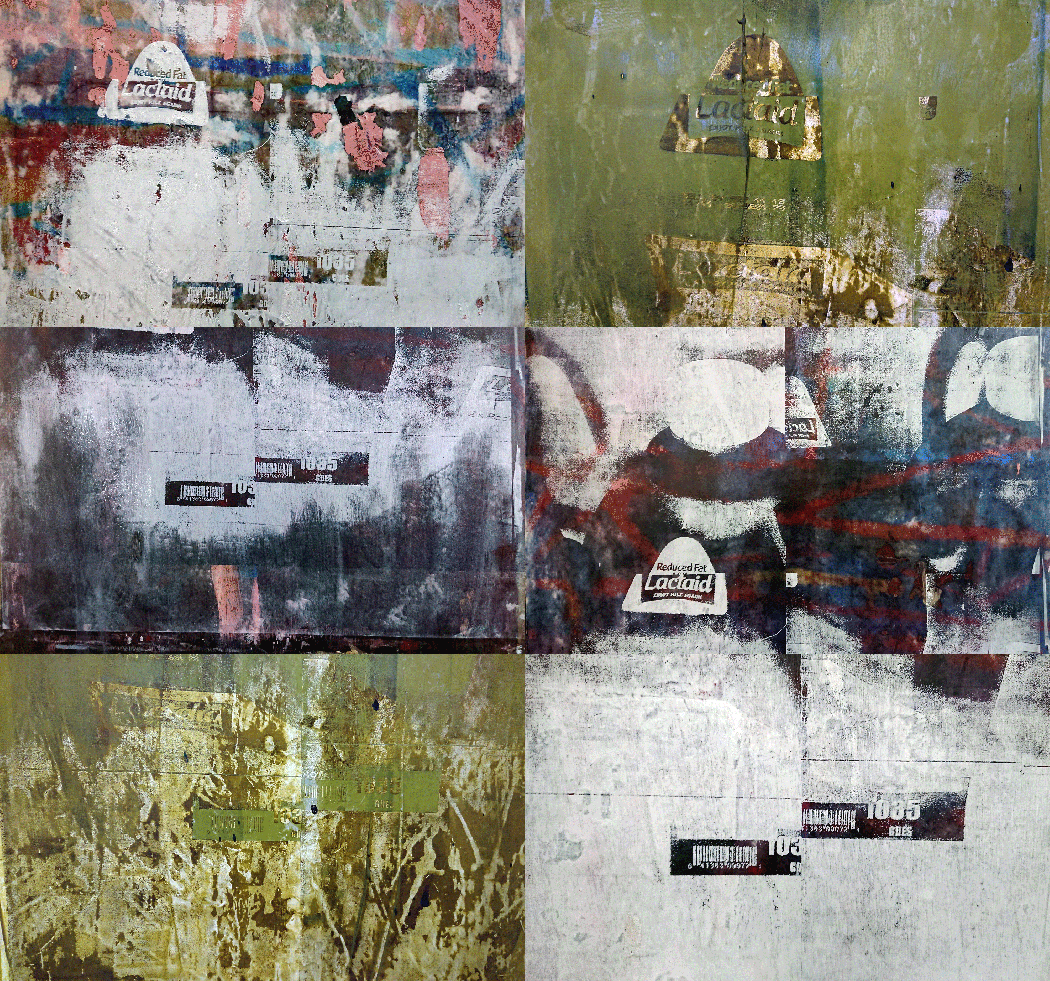
Scale here is very important. It allows for a greater degree of experimenting with an illustration of space, I creates the physicality of the working method and indicates ambition. The painterly space can be elaborated in much more detail, just like in the combination of three overprinted images below. 

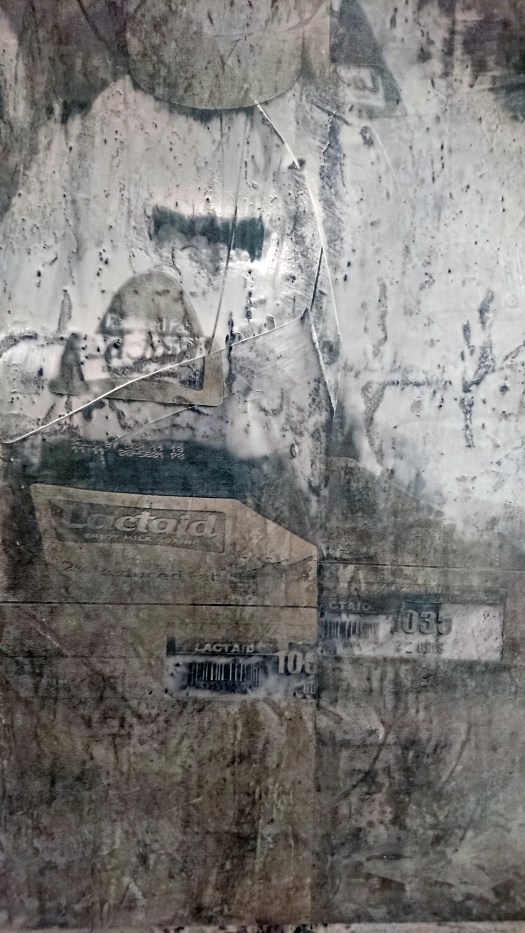
I have experimented again with back lighting of the works in order to discover more sensitive detail. This process has resemblance to the forensics and x-ray techniques. Both are designed to reveal the hidden components, which can potentially affect the overall entity of the works.

The hidden qualities become exposed and elevated to a higher level of the visual hierarchy. 

I am particularly interested in the violence and brutality of the blasting process. I am also impressed by the sensitivity of response of the image to this treatment – the tears and the  dripping of the watery and semi-transparent layers of printing ink.


Blasting of Paintings 3

I have become very intrigued by the process of overprinting a painterly background.  Screen printing technique allows me to manipulate the matrix in order to control both the creation of a new composition and the meaning achieved.  This is done through repetition and the choice of colours in relation to the background as well as the other prints in the existing superimposure.

This effect if subsequently manipulated further through water jet washing and blasting of the wet overprints.  This process gives me much less control.  It is quite violent and spontaneous. The ink splashes all over the spray booth.  Additionally, a range of further effects are achieved through dripping of water and the position of the actual painting during the drying stage.

My creative intention is to continue with this process until I reach the anticipated level of complexity and interaction between individual layers.

As stated in my project proposal, my aim is to discuss the dynamics of a period of 60 seconds of waiting for something to change and happen.  Perhaps, I will try to repeat this process 60 times. The supposedly pointless process of over printing and blasting away with a water jet.  I feel like I am making progress in terms of establishing a framework for the creative process and also with my methodology.

Sixty interventions and “changes” to the image, which are erased as if nothing has ever happened. The memory of the surface implies something different.  Sensitivity of marks and subtlety of this process is something I would like to explore further.


Why Are You Coming Back So Soon…

I have just submitted the following video for a pop up exhibition.

This experimental video is of a series of recently created paintings. The inspiration comes from my experiences in Haiti. I gathered a wide range of primary sources and photographs evidencing my observations and responses to them. The essence of this work is to contradict the rhythm of the painterly process and disturb it with emotional drama inflicted by a long string of messages begging for help and financial assistance. The background narrative – a sexy female voice of a Haitian woman – totally contradicts the drama of the entire situation. She appears to be oblivious to poverty and human struggling. She makes references to her country and the pride of private people. Her vagueness is overwhelming.  The juxtapositioning of the image, the colour of WhatsApp messages and the commentary evokes a totally unreal opposition and clash. It simply etches the intrinsic drama, which is related to the experience of being there and seeing ‘things’.  This is so strange and surreal.

Subsequently, I have booked another trip to go back there at Christmas to revisit the places and refresh my contacts again.

Courful visuals, painterly landscapes, intriguing female voice contrasted with the seriousness of dramatic messages asking for help. I will continue to reflect on this video composition throughout both, the festive season and the forthcoming trip. I am so full of anxiety and fear.

I have also started to feel the impact of ‘reisefieber’ on my well being and my performance at work.

What does the future hold?

Nothing is certain and no one knows.

More No Than Yes

I am trying to embrace the true meaning of messages in the voice recordings below, while looking at still images; staring at them, staring, staring…

Why Are You Coming Back So Soon

I Am Thinking About It

I Know It Is A Very Good Project

More No Than Yes

Just The Usual Stuff

It Is A Cultural Thing

I Am Really Confused

60 Seconds of Waiting For Something To Happen.

Following  a considerable amount of research and critical analysis of my own experimentation, I have slowly started to develop a deeper understanding of my creative intentions. My focus is firmly placed on uncertainties of tomorrow in the context of waiting for change. Time is a very important factor in the proposed intervention. My thinking has been extended by Samuel Beckett’s ‘Waiting for Godot’, supported by considerations of several scientific and philosophical theories of being and perception of time space. I am interested in visualising a period of 60 seconds of waiting for something to happen and change.

60 Seconds are insignificant yet, simultaneously they are also a metaphorical milestone in the context of measuring time: 60 seconds becomes one minute, 60 minutes create one hour.

The plan is to create a series of 60 painting explorations inspired by research from my travels and observations of what people are waiting for, their cravings, dreams and desires. I plan to superimpose my painterly interpretations with photographic and, perhaps video pieces, before transferring them onto mirror card.  This process creates a very important element to my project. It evokes the feeling of ambiguity and unreality. The reflective surface forces the viewer to see his own reflection in the context of the broader work. It provokes a deeper reflection on the nature of uncertainties, their meaning, importance and hierarchy.  It proposes the question of what is important and what is insignificant?  It also reinforces what cannot be ignored as you see your own reflection in the problem.

Reflective surface has been widely investigated by a British artist Anish Kapoor through his ‘Blood Mirror’ series.

Stainless steel and lacquer
198.5×198.5×46 cm

My obsession with measuring time space comes from the earlier discussed artist Roman Opałka and his ‘Counted Paintings’.

Carte de Voyage Detail (2875545 - 2878714), 1965

Roman Opalka

Carte de Voyage Detail (2875545 – 2878714),

1965, Medium:Works on paper, Ink on paper

Size:33 x 24 cm. (13 x 9.4 in.)


I am also looking at Marc Quinn and his piece titled

No Visible Means of Escape IV, 1996


Justine Khamara – Orbital Spin Trick #2, 2103

Justine KHAMARA. 'Looping #3' 2014 (detail)


Self-shredding image by Banksy, “Love Is in the Bin,” , 2018

Rehearsal for shredding Girl with Balloon

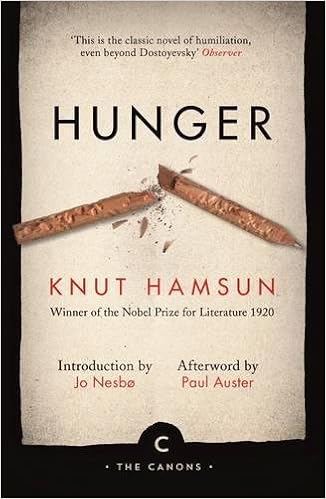
Finally, I have recently read a novel titled “Hunger” by a Norvegian writer called Knut Hamsun.  Throughout the book, there is an overwehelming sense of total isolation accompanied by craving for food and stomach pains.  THe experience is vivid and almost real.
The project aims to interpret 60 Seconds of waiting in anticipation of a change in the context of broad ranging uncertainties of the future.

Can the presence last forever

Will anything ever change?

Will this process have a positive impact on life?

Will my perception of existence continue to deteriorate, while making reality more and more miserable and unsustainable?

My work will be continuously updated and adjusted in the light of new discoveries and research findings until it becomes a comprehensive and holistic appraisal of human uncertainties of the future in the context of my observations and responses.

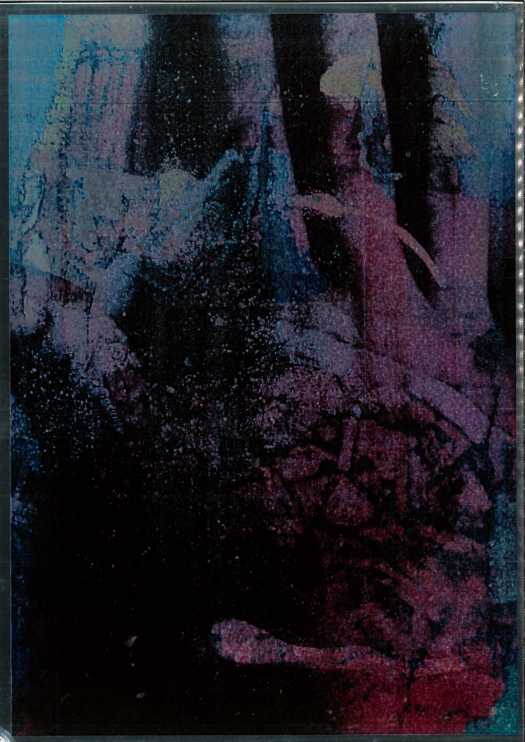
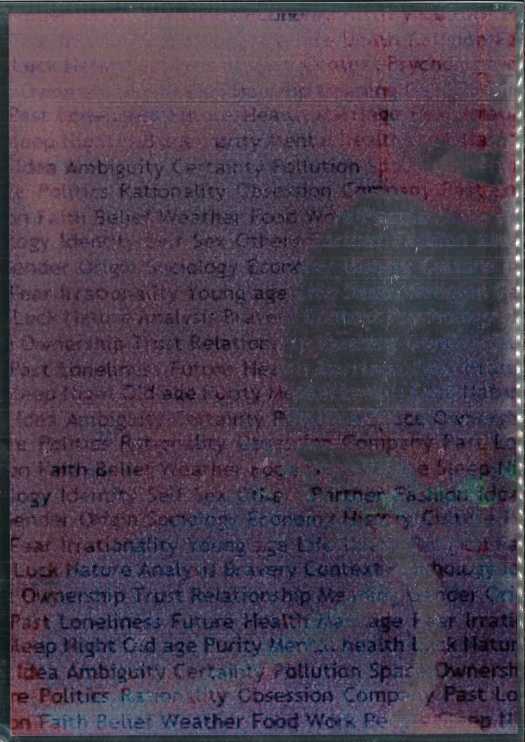
The initial experimentations are below :

First Second:
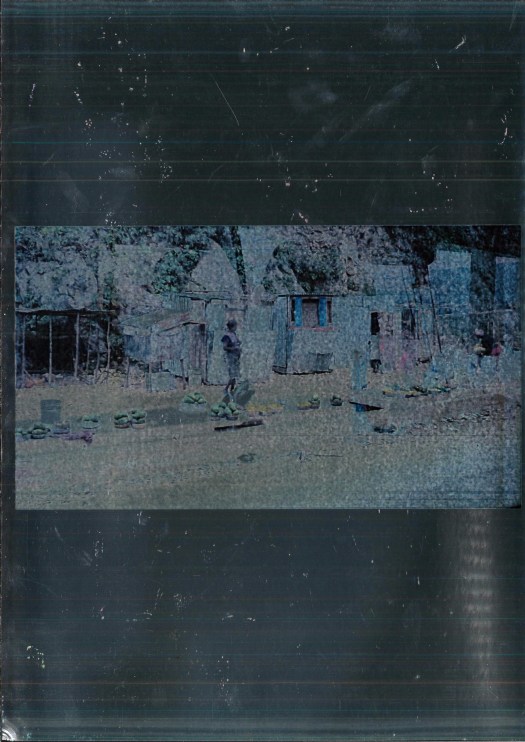
second-4.jpg


Second Second

scanner@sharp.local_20181109_114705_001

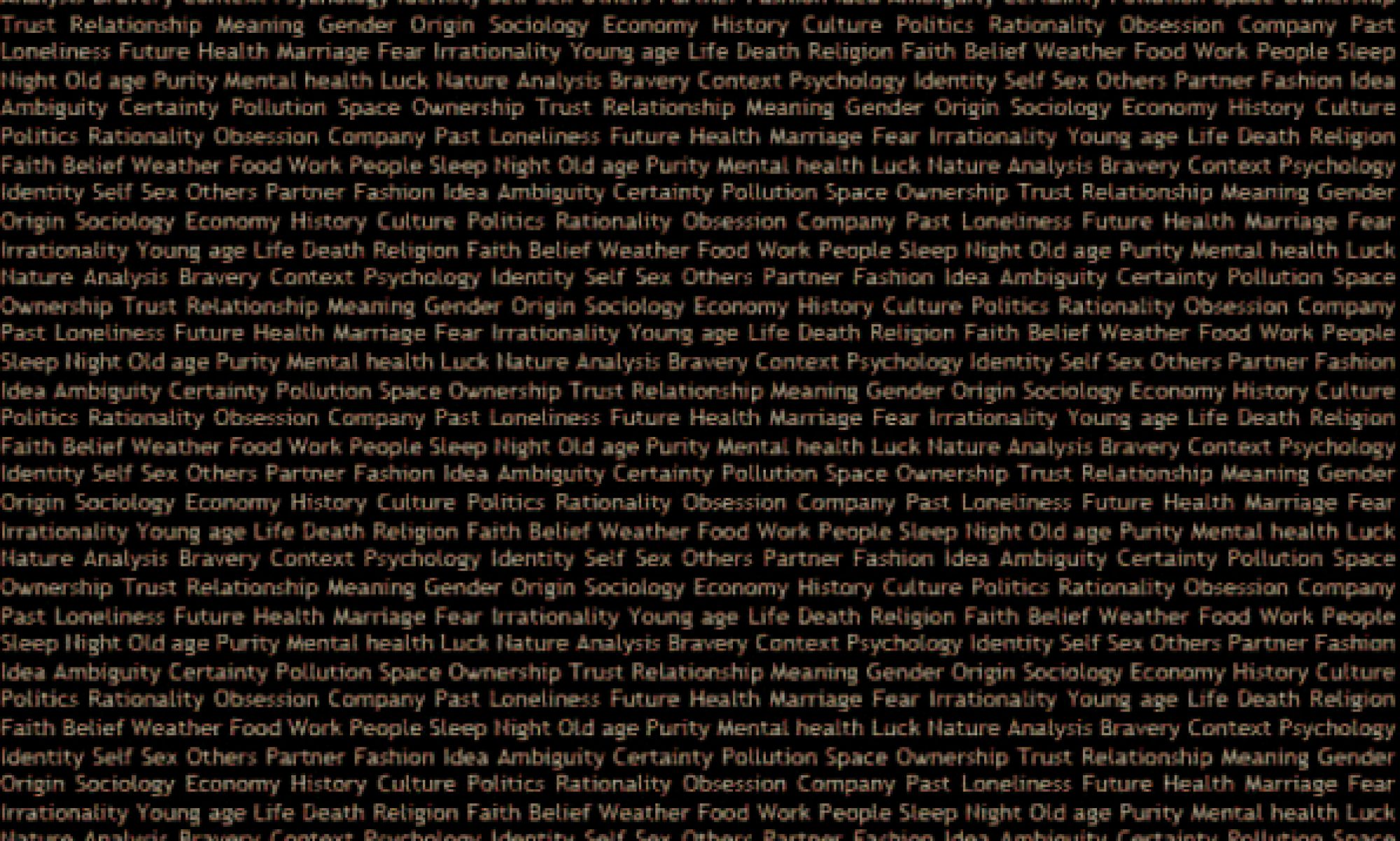
Third Second

scanner@sharp.local_20181109_114620_001.jpg

Fourth Second

scanner@sharp.local_20181109_114546_001